Who Qualifies for GLP-1 Medications and Why It Matters

You qualify for GLP-1 therapy if your BMI is 30 or higher, or 27 or higher with at least one weight-related health condition. That’s the baseline the FDA uses for chronic weight management drugs, and it’s the number every prescriber starts from. But BMI alone doesn’t tell the whole story.
Diabetes-labeled GLP-1s require a documented type 2 diabetes diagnosis, while obesity-labeled versions follow the BMI-and-comorbidity rule instead. A few conditions rule GLP-1 therapy out immediately, no matter how high your BMI climbs:
- You’re pregnant or actively trying to conceive
- You or a close family member has a history of medullary thyroid carcinoma (MTC) or MEN2
- You’ve had pancreatitis triggered by a GLP-1 medication before
- You have severe gastroparesis
The bottom line: meeting the BMI threshold gets your foot in the door. What happens next depends on your medical history, your labs, and how well you and your care team document the rest.
Key Takeaways
GLP-1 eligibility comes down to a documented BMI of 30 or higher, or 27 or higher with a qualifying condition, backed by labs and records payers can verify.
| Point | Details |
|---|---|
| BMI threshold rule | Adults qualify at BMI ≥30, or BMI ≥27 with a documented weight-related condition. |
| Comorbidities need proof | Type 2 diabetes, hypertension, dyslipidemia, OSA, cardiovascular disease, and MASH each require labs, codes, or imaging. |
| Absolute exclusions | Pregnancy, MTC/MEN2 history, severe gastroparesis, and prior GLP-1–induced pancreatitis rule out treatment entirely. |
| Insurers expect objective records | Prior authorization typically requires BMI history, comorbidity evidence, and documented lifestyle-attempt notes. |
| Continuity care improves outcomes | Myanchorhealthpc’s telehealth model tracks documentation, titration, and follow-up needed for safe, covered GLP-1 therapy. |
This article is general information, not a substitute for advice from a qualified doctor. Consult a qualified healthcare professional about your own circumstances before acting on anything here.
Table of Contents
- Which Health Conditions Qualify You at a Lower BMI?
- What Rules Out GLP-1 Therapy Entirely?
- What Happens During a GLP-1 Evaluation?
- How Do You Get Insurance to Cover GLP-1 Treatment?
- Why Continuity Care Makes GLP-1 Treatment Safer
- The Gap Between GLP-1 Marketing and Clinical Reality
- How to Get Evaluated for GLP-1 Therapy With Myanchorhealthpc
- Sources
Which Health Conditions Qualify You at a Lower BMI?
If your BMI sits between 27 and 30, a qualifying condition is what unlocks eligibility. Yale Medicine’s clinical guidance lists the conditions insurers and prescribers accept most consistently:
- Type 2 diabetes
- Hypertension
- Dyslipidemia (high cholesterol or triglycerides)
- Obstructive sleep apnea, confirmed by a sleep study
- Established cardiovascular disease
- Metabolic dysfunction-associated steatohepatitis (MASH) or nonalcoholic fatty liver disease (NAFLD)
None of these get accepted on your word alone. Type 2 diabetes needs an ICD-10 diagnosis code and an A1c reading in your chart. High cholesterol needs an actual lipid panel, not a note that you “probably” have it. Sleep apnea needs a formal sleep study report, and MASH or NAFLD typically needs imaging or, in some cases, a biopsy confirming liver involvement. If you’ve had recent cholesterol testing, pull those numbers before your visit. They speed everything up.
Some conditions sit in a gray zone. Prediabetes, PCOS, and osteoarthritis show up in patient forums as qualifying conditions, but payer acceptance varies widely. One insurer might approve a claim built around prediabetes; another will deny it outright and ask for a full diabetes diagnosis instead. Never assume a borderline condition will fly with your specific plan. Ask your prescriber to check the exact language in your policy before you get your hopes up.

What Rules Out GLP-1 Therapy Entirely?
Some situations aren’t negotiable, and a responsible clinician will flag them before writing a single prescription. Clinical guidance compiled through NCBI’s review of GLP-1 agonists draws a firm line around a small set of absolute contraindications.
- Personal or family history of medullary thyroid carcinoma or MEN2. Animal studies linked GLP-1 receptor agonists to thyroid C-cell tumors; therefore, anyone with this history is excluded outright, no exceptions.
- Pregnancy or active attempts to conceive. GLP-1s aren’t studied for use during pregnancy, so treatment stops the moment pregnancy is confirmed or planned.
- Severe gastroparesis. These drugs slow stomach emptying already; adding that effect on top of an existing motility disorder can cause serious complications.
- Prior pancreatitis triggered by a GLP-1 medication. A repeat episode isn’t a risk worth taking twice.
Beyond the absolute list, several conditions call for extra caution rather than automatic exclusion. Chronic kidney disease, active gallbladder disease, diabetic retinopathy, and a history of pancreatitis from causes other than GLP-1 use all warrant closer monitoring or a specialist consult before starting therapy.
Pro Tip: If MTC or MEN2 runs in your family but no one has confirmed the specific gene, ask your primary care provider about genetic testing before you rule yourself out. A confirmed negative result can reopen the door.
What Happens During a GLP-1 Evaluation?
A real evaluation goes well beyond stepping on a scale. Your clinician will build a complete picture of your medical history, current medications, and any family history of thyroid cancer. If pregnancy is biologically possible, expect a pregnancy test before the first prescription is written. A screening for disordered eating patterns matters too. Behavioral-health screening is a standard part of responsible GLP-1 care, not an optional extra.
Baseline labs typically include:
- A1c and fasting glucose
- A full lipid panel
- A comprehensive metabolic panel covering liver and kidney function
- A pregnancy test, when relevant
- A sleep study or ophthalmology referral, if OSA or retinopathy is suspected
Once therapy starts, dosing follows a slow titration schedule designed to minimize nausea and other side effects. Most protocols follow a similar rhythm:
- Start at the lowest dose and hold for several weeks before increasing.
- Check in early, usually within the first month, to catch side effects before they become a reason to quit.
- Track weight-loss progress against payer benchmarks, often looking for at least 5% loss by the three-to-six-month mark.
- Adjust, pause, or discontinue therapy if progress stalls or side effects outweigh the benefit.
That titration and follow-up rhythm is exactly where ongoing telehealth management either works or falls apart. Skipping the early check-ins is one of the most common reasons people quit GLP-1 therapy before it has a chance to work.
How Do You Get Insurance to Cover GLP-1 Treatment?
Insurers want proof, not a summary. Most prior-authorization requests follow a fairly predictable checklist:
- Documented BMI readings from more than one visit, not a single measurement
- Objective evidence of a qualifying comorbidity: a lab result, a diagnosis code, a sleep study
- Notes showing a supervised lifestyle attempt, usually spanning three to six months
- Records of any prior weight-loss medications you’ve tried, if your payer asks for that history
Before your visit, gather your recent weight history, your latest labs, and any sleep study or prior program documentation you already have. Coming prepared, rather than reconstructing your history on the spot, is one of the biggest levers you control in this process.
Pro Tip: Payers rarely take your word for it. A patient-facing checklist like the one from GLPCare can help you organize your records before your appointment so nothing slows down the review.
If coverage gets denied, you’re not out of options. Appeals are common, and many succeed once missing documentation gets filled in. Medicare beneficiaries should also know about the CMS GLP-1 Bridge demonstration, a limited program offering temporary access under specific criteria. And cash-pay remains a real path for some patients, though it still requires the same medical supervision and follow-up as insured care. Skipping monitoring to save money is never worth the risk.
Why Continuity Care Makes GLP-1 Treatment Safer
GLP-1 therapy isn’t a prescription you fill once and forget. It’s a chronic-disease treatment that needs a consistent relationship with someone who already knows your history. That’s the foundation of our Anchored Care℠ᴵᴾ model at Myanchorhealthpc: the same provider tracking your BMI trend, your labs, and your response over time, rather than a different face at every visit.
Telehealth removes a lot of the friction that keeps people from staying on track:
- Visits that fit into a workday without a commute
- Coordination with local labs for A1c, lipid panels, and metabolic testing
- Referrals to sleep specialists or endocrinologists when your case calls for it
- Structured behavioral-health support built into the same care relationship, not a separate referral you have to chase down
A patient who starts GLP-1 therapy without a plan for follow-up is far more likely to face a coverage gap, a missed side effect, or a stalled reauthorization. Continuity of care isn’t a nice extra here. It’s the mechanism that keeps documentation current and treatment safe.
The Gap Between GLP-1 Marketing and Clinical Reality
Most of what circulates about GLP-1 eligibility online treats it like a yes-or-no gate: hit the BMI number, get the prescription. That framing undersells how much clinical judgment actually goes into a responsible evaluation, and it sets people up to feel blindsided when a prescriber asks for a sleep study or a behavioral-health screen they didn’t expect.
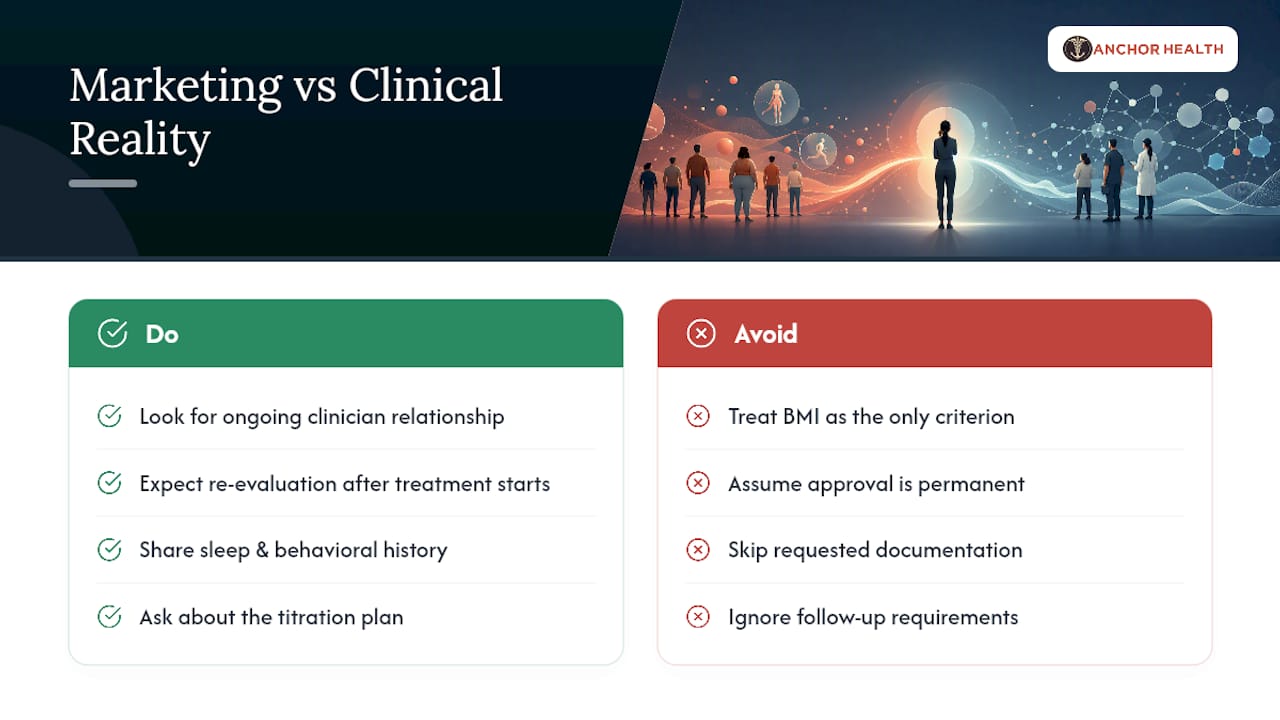
The conventional advice also underplays how much re-evaluation matters after the first prescription. Too many patient guides stop at “here’s how to qualify” and never mention what happens six months in.
If there’s one thing worth prioritizing above the BMI math, it’s finding a clinician who treats this as an ongoing relationship rather than a single transaction. The documentation, the titration schedule, and the reauthorization benchmarks all depend on someone tracking your case over time, not just approving it once.
— Paule
How to Get Evaluated for GLP-1 Therapy With Myanchorhealthpc
If you’ve read this far and suspect you qualify, the next move is a real clinical evaluation, not a guess. Myanchorhealthpc runs that evaluation through secure video visits, covering your BMI history, relevant labs, behavioral-health screening, and medication review in one appointment, without the rushed, fragmented feel of a typical walk-in visit.

Your first appointment includes a full history review, coordination with local labs for A1c or lipid testing when needed, and a clear conversation about whether your case fits the BMI-and-comorbidity criteria payers require. If it does, we document everything your insurer needs for prior authorization, from diagnosis codes to supervised lifestyle notes. Membership options are available for patients who want extended follow-up and faster access between visits. Whether you’re managing type 2 diabetes, high blood pressure, or a BMI that’s climbed past 30, choosing a telehealth primary care provider built around continuity gives your GLP-1 evaluation a real chance at approval and long-term success. Schedule your visit online to get started.
Sources
- FDA approves new medication for chronic weight management
- GLP-1 Medications for Weight Loss: How to Get Started | Yale Medicine
- GLP-1 agonists — clinical review (NCBI Bookshelf)
- Common GLP-1 questions answered — U of U Health
- GLP-1 qualifications: BMI, comorbidities, age, insurance criteria
Recommended
- Prediabetes Primary Care: What Adults Need to Know
- Telehealth vs Endocrinologist for Chronic Care in Maryland
- Your Cholesterol Numbers Explained: What Each One Means
- How Primary Care Prevents Diabetes Complications
Blog & Information Disclaimer
Last Updated: May 23, 2026
The information provided on the Anchor Health website (https://myanchorhealthpc.com/), including but not limited to blog posts, articles, newsletters, graphics, and other materials (collectively, the "Content"), is for general informational and educational purposes only.
By accessing and using this website, you acknowledge and agree to the following terms and conditions:
The Content on this website is not intended to be a substitute for professional medical advice, diagnosis, or treatment. Always seek the advice of your physician, nurse practitioner, or other qualified health provider with any questions you may have regarding a medical condition. Never disregard professional medical advice or delay in seeking it because of something you have read on this website.
Reading, interacting with, or sharing the Content on this website does not establish a patient-provider relationship between you and Anchor Health or any of its clinicians, including Paule Valery Joseph, PhD, MBA, CRNP, FAAN. A formal patient-provider relationship is only established after you have completed the formal intake process, signed our clinical consent forms, and participated in a secure clinical consultation.
If you are experiencing a medical emergency, call 911 or seek emergency medical services immediately.
Anchor Health is a primary care practice and does not provide emergency or crisis intervention services through its website or blog.
While Anchor Health strives to provide thoughtful, evidence-based information grounded in our Anchored Care℠ model, healthcare is a rapidly evolving field. We make no representations or warranties, express or implied, about the completeness, accuracy, reliability, or suitability of the information contained in the Content. Any reliance you place on such information is strictly at your own risk.
Anchor Health is a telehealth practice providing services to patients physically located within the state of Maryland. The information provided on this blog is intended for residents of Maryland and is governed by the laws and regulations of that state. Accessing this information from outside of Maryland does not imply that our clinicians are licensed to practice medicine or provide consultations in your jurisdiction.
Content related to Weight & Metabolic Health, including discussions of GLP-1 medications or other medical therapies, is provided for educational context regarding our clinical approach. Prescriptions and specific medical recommendations are only made following a comprehensive clinical evaluation, diagnostic testing, and shared decision-making within a formal patient-provider relationship.
This website may contain links to external websites that are not provided or maintained by or in any way affiliated with Anchor Health. Please note that Anchor Health does not guarantee the accuracy, relevance, timeliness, or completeness of any information on these external websites.
To the fullest extent permitted by law, Anchor Health, its owners, and its employees shall not be liable for any direct, indirect, incidental, consequential, or punitive damag
Related posts