Why Establishing Primary Care in Young Adulthood Matters

Establishing a primary care relationship in young adulthood creates a medical home that prevents disease, coordinates specialty care, and positions you as an active decision-maker in your own health. Research from the NIH confirms that high-quality primary care is foundational to better population health and equity. The WHO defines primary health care as integrated, people-centered care spanning prevention through chronic disease management. Yet a national survey reported by CNN found that more than 1 in 4 young adults lack a primary care provider, and only 47% of 18–29-year-olds had an annual wellness visit in the past year. That gap has real consequences.
Why establishing primary care in young adulthood matters comes down to one practical reality: the habits and relationships you build now shape your health trajectory for decades. Providers like Myanchorhealthpc, which delivers Anchored Care℠ through secure telehealth visits in Maryland, show that accessing this kind of relationship-based care has never been more straightforward.
- You gain a clinician who knows your full history, not just today’s complaint.
- Preventive screenings get scheduled and tracked, not forgotten.
- Mental health, metabolic health, and chronic conditions are caught early.
- Referrals to specialists happen through a trusted coordinator, not a cold search.
Pro Tip: Schedule or confirm a primary care visit this week. Even a single telehealth appointment starts the record and the relationship.
Key Takeaways
| Point | Details |
|---|---|
| Start during the transition window | Ages 18–25 are the highest-leverage period to establish a PCP and build lasting health habits. |
| Screening completion rises with a PCP | PCP visits after leaving pediatric care are linked to a 12%–21% higher likelihood of completing recommended screenings. |
| Telehealth removes the main barriers | Scheduling and geography are the top obstacles; telehealth resolves both without sacrificing continuity. |
| Use the 7-step checklist | Verify insurance, collect records, book a visit, prepare an agenda, and set a follow-up before you leave. |
| Myanchorhealthpc offers Anchored Care℠ | Maryland young adults can establish telehealth primary care through Myanchorhealthpc, with insurance, self-pay, and membership options available. |
Table of Contents
- What does a primary care medical home actually do for you?
- What does the evidence say about primary care and better outcomes?
- Why ages 18–25 are a critical window for establishing primary care
- Concrete short- and long-term benefits you’ll notice from having a PCP
- What barriers keep young adults from getting a PCP, and how do you fix them?
- How do you choose a primary care provider and what should you ask?
- How does telehealth primary care support young adults?
- When should you use urgent care or the ER instead of your PCP?
- Your 7-step checklist to establish primary care this week
- Why I recommend establishing primary care now
- Myanchorhealthpc makes establishing primary care straightforward for young adults
- Sources
What does a primary care medical home actually do for you?
A “medical home” is not a building. It is a framework of relationship-based, continuous care where one clinician or practice knows your full health picture. The core functions of primary care include preventive screening, chronic condition monitoring, care coordination, and whole-person support that connects medical, behavioral, and social services. Primary care acts as the front door of the health system, improving equity and life expectancy by providing whole-person care that links medical, behavioral, and social services.
Urgent care and emergency rooms serve a different purpose entirely. They address the immediate problem in front of them, with no access to your longitudinal record and no mandate to follow up. As physician Dr. Leana Wen has noted:
Primary care also centralizes your records, reducing duplicate testing and the risk of drug interactions when a specialist prescribes something new. That coordination function alone saves time, money, and potential harm.
What does the evidence say about primary care and better outcomes?
The evidence is consistent and spans decades. A NASEM committee report concluded that high-quality primary care is a foundational “common good” that improves population health, equity, and system cost-effectiveness, and that it requires sustained patient-clinician relationships to deliver those benefits. Literature reviews show that continuity with a regular primary care practitioner is associated with reduced emergency and specialist use, fewer hospitalizations, better preventive care, and lower costs.
For young adults specifically, a PMC study found that those who saw an adult PCP after leaving pediatric care had substantially higher preventive screening completion rates, with PCP visits linked to a 12%–21% increased likelihood of completing recommended screenings. Mental health screening rates doubled in that cohort.
Statistic to know: Young adults with an established PCP are 12%–21% more likely to complete recommended preventive screenings than those without one.
| Outcome | Finding | Source |
|---|---|---|
| Preventive screening completion | 12%–21% increased likelihood with PCP visits post-transition | PMC (Transition to adult care study) |
| Mental health screening | Doubled in young adults who established adult PCP | PMC (Transition to adult care study) |
| ER and specialist use | Reduced with continuity of primary care | PMC (Contribution of Primary Care) |
| Hospitalizations | Fewer with a regular primary care practitioner | PMC (Contribution of Primary Care) |
| Population health equity | Improved in primary care-oriented health systems | WHO / NASEM |
The WHO underscores that primary care-oriented systems are more equitable and cost-effective, a finding that holds across income levels and geographies.
Why ages 18–25 are a critical window for establishing primary care
Turning 18 triggers a cascade of changes that make this window uniquely important. Privacy rules shift: your health information is now yours alone. Insurance coverage often changes, whether through a parent’s plan, a new employer, or a marketplace policy.
The transition from pediatric to adult care is also a structural gap. Many young adults simply age out of their pediatrician’s practice without a warm handoff to an adult provider. Research confirms that meeting with an adult PCP in the 18 months after that transition is associated with significantly higher screening completion rates. The sequence typically looks like this:
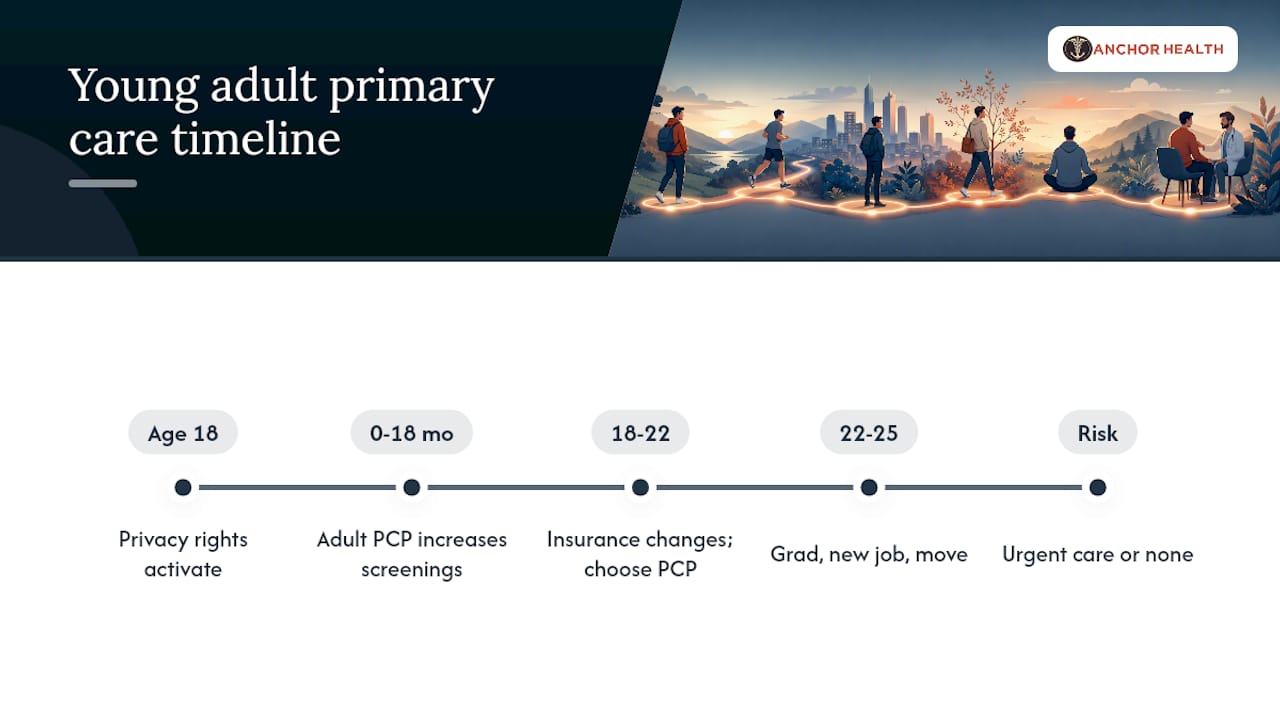
Age 18: Privacy rights activate; pediatrician may begin discussing transition.
Age 18–22: Insurance coverage often changes; first opportunity to select an adult PCP.
Age 22–25: College graduation, new employment, or relocation creates natural re-enrollment moments.
Each of these transitions is also a risk point. Without a PCP in place, young adults default to urgent care or simply go without care until something goes wrong.
Pro Tip: Before your first adult visit, prepare a one-page health summary: your immunization history, any chronic conditions, current medications, and your family history. Clinicians at the Mott Poll recommend this step to shorten onboarding and help your new provider identify risks quickly.
Concrete short- and long-term benefits you’ll notice from having a PCP
The benefits split cleanly into what you feel now and what you protect for later.
Short-term wins:
- Same-day guidance on symptoms without an ER trip
- Prescription continuity when you move or change insurance
- Vaccination updates (HPV, meningitis, flu) tracked in one place
- Mental health check-ins built into routine visits
- Referrals to specialists handled by someone who knows your history
Long-term wins:
- Earlier detection of conditions like hypertension, prediabetes, and thyroid disorders
- Lower lifetime healthcare costs through prevention rather than crisis management
- A complete medical record that follows you across life stages
- Reduced risk of duplicate testing and medication conflicts
| Timeframe | Outcome | Who benefits most |
|---|---|---|
| Short-term | Same-day advice, prescription continuity, vaccinations | College students, new employees |
| Short-term | Mental health screening and referrals | Young adults managing stress or anxiety |
| Long-term | Chronic disease prevention and early detection | Anyone with family history of diabetes, heart disease |
| Long-term | Lower costs, fewer ER visits, coordinated specialty care | All young adults with insurance or self-pay access |
A student moving for college, for example, benefits immediately from having a provider who can manage prescription refills remotely. Someone starting a new job with benefits gains the most from scheduling a baseline wellness visit before any health issue arises. For those beginning weight or metabolic care, a PCP who tracks trends over time makes treatment far more effective than episodic clinic visits.

What barriers keep young adults from getting a PCP, and how do you fix them?
The most common obstacles are practical, not personal. Insurance transitions create confusion about which providers are in-network. Provider shortages in some regions mean months-long waits for new patients. Cost concerns stop many young adults from booking even a first visit.
Practical fixes that work:
- Verify your insurance first. Call the member services number on your card and ask for a list of in-network primary care providers accepting new patients.
- Use telehealth. Telehealth removes transportation and scheduling barriers, and many providers offer same-week availability. Learn more about how telehealth removes barriers for young patients.
- Ask about sliding scale or membership options. Community health centers use income-based fees. Membership-based practices offer predictable monthly costs.
- Bring documentation. Arriving with your insurance card, a medication list, and your immunization record speeds up enrollment and reduces the chance of a second visit just for paperwork.
Cultural fit matters too. If you have not felt heard by a provider before, it is reasonable to ask about a practice’s approach to communication and continuity before booking.
How do you choose a primary care provider and what should you ask?
The right PCP for you depends on five factors: availability (including telehealth and after-hours access), continuity (will you see the same clinician each visit), scope of services (behavioral health, women’s health, metabolic care), payment model (insurance, self-pay, membership), and cultural fit.
Questions to ask when booking or at your first visit:
- Will I see the same clinician at each visit, or rotate through staff?
- Do you offer telehealth appointments for routine follow-ups?
- How do you handle referrals to specialists?
- What mental health or behavioral health support do you provide within primary care?
- What are your payment options if my insurance changes?
- How quickly can I reach someone for an urgent question between visits?
- Do you offer extended or same-day appointments?
Red flags to watch for: no clear continuity of care, an unclear referral process, no way to reach the practice between scheduled visits, and pressure to use urgent care for issues that should be managed longitudinally.
Before your first appointment, prepare three things: a medication list with dosages, your family health history (parents, grandparents, siblings), and two or three specific health goals or questions you want to address. Clinicians consistently note that patients who arrive with a prepared agenda get more from the visit.
How does telehealth primary care support young adults?
Telehealth removes the two barriers young adults cite most often: scheduling conflicts and geographic distance. A secure video visit fits into a lunch break, a study period, or a work-from-home morning in a way that an in-person appointment rarely does. Follow-up visits, prescription renewals, and mental health check-ins all translate well to video.
Myanchorhealthpc’s Anchored Care℠ model is built around exactly this kind of continuity. Delivered entirely through secure telehealth visits in Maryland, it pairs relationship-based primary care with a full scope of services: general medicine, women’s health across reproductive and menopause stages, mental and emotional health support within primary care scope, and weight and metabolic health management including GLP-1 medications where appropriate. The practice accepts insurance, self-pay, HSA/FSA funds, and offers an optional membership for enhanced access and longer visits.
Pro Tip: Use telehealth for routine follow-ups and prescription management. Reserve in-person visits for physical exams, lab draws, or procedures that genuinely require them. This hybrid approach keeps your care continuous without adding friction.
When should you use urgent care or the ER instead of your PCP?
Knowing when to route care correctly protects both your health and your continuity of care.
Go to the ER immediately for: chest pain, difficulty breathing, signs of stroke (sudden facial drooping, arm weakness, speech difficulty), severe allergic reactions, major injuries, or loss of consciousness.
Urgent care is appropriate for: minor injuries (sprains, cuts), fever without serious symptoms, urinary tract infections, and illnesses that need same-day attention when your PCP is unavailable.
Your PCP handles: annual wellness visits, chronic condition management, mental health screening, prescription renewals, preventive screenings, and follow-up after any urgent or ER visit.
That last point matters. As Dr. Leana Wen has noted, urgent care does not track long-term health patterns or coordinate specialty care. After any urgent or ER visit, schedule a follow-up with your PCP so the encounter enters your longitudinal record and any needed follow-up care gets coordinated. Telehealth makes this step easy; a 15-minute video visit is often enough to close the loop.
Your 7-step checklist to establish primary care this week
- Verify your insurance. Confirm your current plan, find in-network PCPs accepting new patients, and note your copay or deductible.
- Collect your records. Gather immunization history, current medications with dosages, and any known diagnoses or allergies.
- Pick two or three candidate providers. Use your insurer’s directory or a telehealth platform. Check for telehealth availability and same-week scheduling.
- Schedule your first visit. Book the appointment. A telehealth option reduces friction significantly.
- Prepare a three-item agenda. Write down your top health goal, one concern you have been putting off, and your family history highlights.
- Set a follow-up before you leave. Ask at the end of the first visit when you should return and put it in your calendar.
- Save your PCP’s contact information. Add the practice number and patient portal login to your phone and a secure digital folder.
Use the young adult preventive health checklist to confirm which screenings are due at your age.
Pro Tip: If in-person availability is limited in your area, a telehealth-first practice like Myanchorhealthpc lets you complete steps 4 through 6 entirely via video, often within the same week.
Why I recommend establishing primary care now
The evidence for early primary care is not ambiguous. Young adults who establish a PCP in their 20s complete more screenings, use the ER less, and enter their 30s with a health record that actually reflects their history. The transition out of pediatric care is a real gap in the system, and the young adults who close it proactively are the ones who catch conditions early and manage them on their terms. Waiting until something goes wrong is not a strategy. Building a relationship with a trusted, consistent provider now is.
Myanchorhealthpc makes establishing primary care straightforward for young adults
Young adults in Maryland who want relationship-based primary care without the wait, the commute, or the fragmented experience of urgent care have a direct path forward with Myanchorhealthpc. The Anchored Care℠ model delivers continuity through secure video visits, covering general medicine, women’s health, mental and emotional health support, and weight and metabolic care including GLP-1 management where appropriate. The practice accepts insurance, self-pay, HSA/FSA funds, and offers a membership option for longer visits and enhanced follow-up access.
Starting is simple. Visit the telehealth primary care guide to understand your options, or book a first visit directly. Your medical home starts with one appointment.
Sources
The following sources informed this article. Each is linked directly to the claim it supports in the body text above.
Key sources used:
- Why more than 1 in 4 Gen Zers don’t have primary care doctors | CNN — National survey data on young adult PCP access and wellness visit rates; Dr. Leana Wen commentary on urgent care limits.
- Summary: Implementing High-Quality Primary Care | NCBI Bookshelf — NASEM committee report on primary care as a foundational common good requiring sustained relationships.
- Transition to adult care and preventive screening outcomes | PMC — Study showing 12%–21% increased screening completion and doubled mental health screening rates with adult PCP visits post-transition.
- The Role of Primary Care in Improving Population Health | PMC — Literature review on whole-person care, equity, and care coordination.
- Contribution of Primary Care to Health Systems and Health | PMC — Evidence on continuity reducing ER use, hospitalizations, and costs.
- Primary health care | WHO — WHO definition of integrated, people-centered primary health care and equity evidence.
- Handing over responsibility for health and healthcare | Mott Poll — Practitioner guidance on preparing for the pediatric-to-adult care transition.
Further reading from Myanchorhealthpc:
- Why more than 1 in 4 Gen Zers don’t have primary care doctors | CNN
- Summary – Implementing High-Quality Primary Care – NCBI Bookshelf
- The Role of Primary Care in Improving Population Health – PMC
- Primary health care – WHO
- Handing over responsibility for health and healthcare – Mott Poll
This article is general information, not a substitute for advice from a qualified doctor. Consult a qualified healthcare professional about your own circumstances before acting on anything here.
Recommended
- Preventive Care for Ages 18–25: Your 2026 Guide
- Young Adult Preventive Health Checklist: 2026 Guide
- Family Primary Care Best Practices for Every Age
- Primary Care’s Role in Caregiver Preventive Screenings
Blog & Information Disclaimer
Last Updated: May 23, 2026
The information provided on the Anchor Health website (https://myanchorhealthpc.com/), including but not limited to blog posts, articles, newsletters, graphics, and other materials (collectively, the "Content"), is for general informational and educational purposes only.
By accessing and using this website, you acknowledge and agree to the following terms and conditions:
The Content on this website is not intended to be a substitute for professional medical advice, diagnosis, or treatment. Always seek the advice of your physician, nurse practitioner, or other qualified health provider with any questions you may have regarding a medical condition. Never disregard professional medical advice or delay in seeking it because of something you have read on this website.
Reading, interacting with, or sharing the Content on this website does not establish a patient-provider relationship between you and Anchor Health or any of its clinicians, including Paule Valery Joseph, PhD, MBA, CRNP, FAAN. A formal patient-provider relationship is only established after you have completed the formal intake process, signed our clinical consent forms, and participated in a secure clinical consultation.
If you are experiencing a medical emergency, call 911 or seek emergency medical services immediately.
Anchor Health is a primary care practice and does not provide emergency or crisis intervention services through its website or blog.
While Anchor Health strives to provide thoughtful, evidence-based information grounded in our Anchored Care℠ model, healthcare is a rapidly evolving field. We make no representations or warranties, express or implied, about the completeness, accuracy, reliability, or suitability of the information contained in the Content. Any reliance you place on such information is strictly at your own risk.
Anchor Health is a telehealth practice providing services to patients physically located within the state of Maryland. The information provided on this blog is intended for residents of Maryland and is governed by the laws and regulations of that state. Accessing this information from outside of Maryland does not imply that our clinicians are licensed to practice medicine or provide consultations in your jurisdiction.
Content related to Weight & Metabolic Health, including discussions of GLP-1 medications or other medical therapies, is provided for educational context regarding our clinical approach. Prescriptions and specific medical recommendations are only made following a comprehensive clinical evaluation, diagnostic testing, and shared decision-making within a formal patient-provider relationship.
This website may contain links to external websites that are not provided or maintained by or in any way affiliated with Anchor Health. Please note that Anchor Health does not guarantee the accuracy, relevance, timeliness, or completeness of any information on these external websites.
To the fullest extent permitted by law, Anchor Health, its owners, and its employees shall not be liable for any direct, indirect, incidental, consequential, or punitive damag
Related posts