Why Family Medicine Covers All Ages: A Family Guide

Family medicine covers all ages because its residency training, whole-person philosophy, and medical-home model are built from the ground up to provide continuous care from newborns through older adults. The American Academy of Family Physicians states plainly that family physicians are the only specialists qualified to treat most ailments and give comprehensive health care to people of all ages. Research published in PMC shows that adding just 10 family physicians per 100,000 people produces 15 fewer deaths and 40 fewer hospitalizations per year, along with an average life-expectancy gain of 52 days. That kind of population-level impact is possible precisely because family medicine is designed to stay with patients across every life stage, not hand them off when they age out of a specialty’s range. Myanchorhealthpc applies this same lifespan model through its Anchored Care℠ᴵᴾ telehealth practice in Maryland.
Table of Contents
- What is family medicine, and what does “whole-person care” mean?
- Why family medicine covers all ages: training and residency scope
- What does a family physician actually do at each life stage?
- What are the measurable benefits of having one physician for all ages?
- How does family medicine differ from pediatrics, internal medicine, geriatrics, and OB/GYN?
- When do family physicians refer to specialists?
- How do you choose a family physician who can truly serve your whole family?
- How Myanchorhealthpc delivers longitudinal family medicine via telehealth
- How family medicine developed its lifespan philosophy
- Why cultural competence and family dynamics shape care across ages
- What challenges come with caring for multiple age groups, and how are they managed?
- What multigenerational care looks like in practice
- Key Takeaways
- The case for staying with one provider across a lifetime
- Myanchorhealthpc brings family medicine’s lifespan approach to telehealth
- Useful sources
What is family medicine, and what does “whole-person care” mean?
Family medicine is a primary-care specialty organized around long-term, continuous relationships with patients of every age, gender, and health status. Where cardiology focuses on the heart and pediatrics focuses on children, family medicine focuses on the person, across time and across conditions.
The concept at the center of this specialty is the medical home: a single, trusted clinical relationship that coordinates all aspects of a patient’s care, including physical health, mental health, social circumstances, and cultural context. Rather than treating isolated symptoms, a family physician builds enough history with a patient to recognize patterns, catch risks early, and coordinate specialist care when needed.
The medical-home model is what separates family medicine from a series of disconnected urgent-care visits. Mayo Clinic Health System describes family medicine teams as providing preventive care, chronic disease management, and coordinated specialty referrals across life stages, all anchored in a single ongoing relationship.
Why family medicine covers all ages: training and residency scope
The short answer is that family medicine residency is deliberately structured to produce physicians who are competent across the entire human lifespan. That breadth is not accidental; it is a certification requirement.
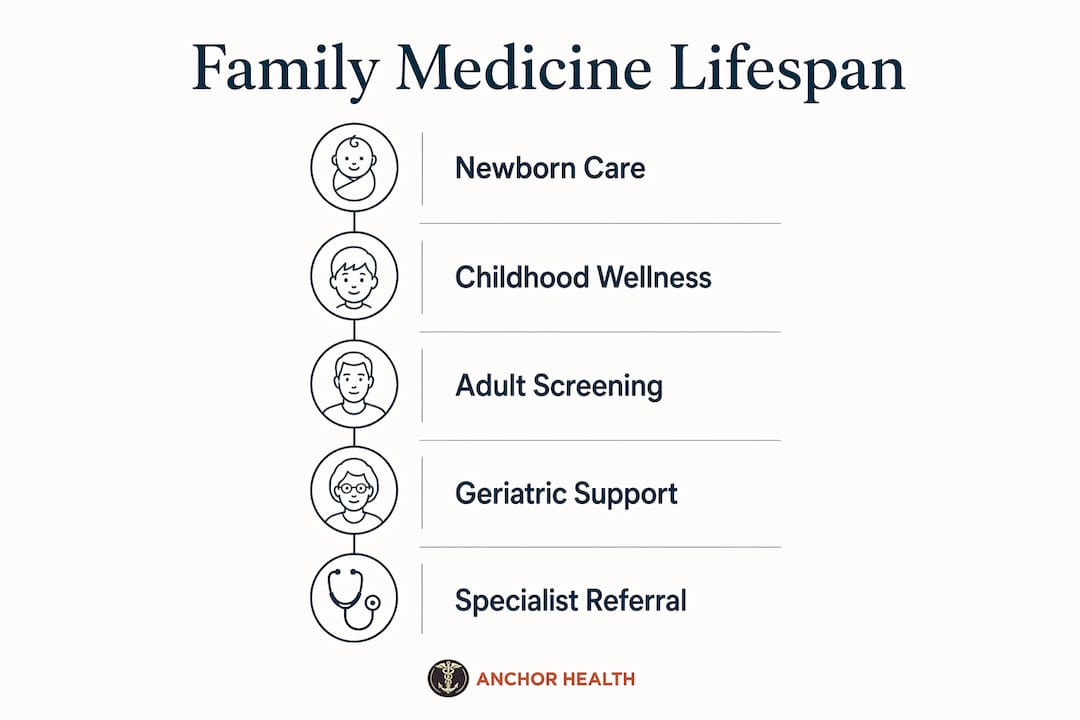
After four years of medical school, family medicine residents complete a three-year residency that rotates through a wider range of clinical settings than virtually any other specialty. As the Cleveland Clinic notes, family medicine residencies include pediatrics and obstetrics rotations that internal medicine programs do not require, which is the structural reason family physicians can treat children and support pregnancies while internists typically focus on adults 18 and older.
Core rotations that give family physicians their lifespan breadth include:
- Pediatrics: newborn nursery, well-child visits, acute illness management in children
- Obstetrics and gynecology: prenatal care, labor and delivery, postpartum support, contraception
- Internal medicine: adult chronic disease, hospital medicine, complex multi-system conditions
- Geriatrics: polypharmacy management, cognitive decline, functional assessment in older adults
- Behavioral health: depression, anxiety, substance use, ADHD across age groups
- Outpatient continuity clinics: longitudinal patient panels seen throughout the three years of training
Board certification through the AAFP requires passing a comprehensive exam that spans all of these domains. Beyond the core residency, many family physicians pursue additional fellowships in sports medicine, emergency medicine, or geriatrics. The AAFP also notes that family physicians routinely perform in-office procedures such as skin biopsies, joint injections, and contraceptive device placement, reducing the need for specialist referrals on common issues.
What does a family physician actually do at each life stage?
The scope described in training translates into concrete services that families can recognize across the years.
Newborns and infants receive well-baby checks, immunization series, newborn feeding support, and developmental monitoring. A family physician who attended the delivery can continue as that child’s primary provider from day one, creating genuine continuity rather than a handoff between an obstetrician and a new pediatrician.

Children and adolescents benefit from developmental screenings, school and sports physicals, vaccination updates, and management of conditions like ADHD, asthma, and anxiety. Adolescent care also includes confidential conversations about mental health, substance use, and reproductive health, areas where a trusted, ongoing relationship matters more than clinical protocol alone. Age-specific preventive care guidance for young adults extends this continuity into early adulthood.
Adults receive preventive screenings (blood pressure, cholesterol, diabetes, cancer), chronic disease management for conditions like hypertension and type 2 diabetes, and women’s reproductive health care including contraception counseling and perimenopause support. Men’s health, weight management, and mental health integration also fall within this scope.

Older adults need a different kind of attention: polypharmacy reviews to catch dangerous drug interactions, falls-risk assessments, cognitive screening, and advance care planning. A family physician who has known a patient for decades brings irreplaceable context to those conversations.
Throughout all of these stages, the family physician decides when to deliver care directly and when to coordinate a referral, acting as the hub of a patient’s broader care network.
What are the measurable benefits of having one physician for all ages?
The population-level evidence for family medicine is consistent and striking. According to PMC peer-reviewed research, for every additional 10 family physicians per 100,000 people, communities see:
| Outcome | Effect |
|---|---|
| Annual deaths | 15 fewer per 100,000 people |
| Annual hospitalizations | 40 fewer per 100,000 people |
| Life expectancy | +52 days on average increase |
Continuity of care, the defining feature of family medicine, is independently associated with reduced emergency visits, fewer hospital admissions, lower readmission rates, and lower all-cause mortality. The same PMC review found cost reductions in multiple cohort studies when patients maintained high continuity with a single primary-care provider.
Key finding: Continuity of primary care is associated with lower emergency department use, fewer hospitalizations, and reduced all-cause mortality across multiple systematic reviews and cohort studies.
The AAFP reports that access to a family physician is associated with higher immunization rates, lower infant mortality, and higher birth weights, outcomes that reflect the medical-home model’s emphasis on prevention across the lifespan. For families managing chronic conditions, primary care’s role in chronic disease management is a direct driver of those hospitalization reductions.
The mechanism behind these numbers is straightforward: a physician who knows a patient’s full history catches warning signs earlier, avoids redundant testing, and coordinates care more efficiently than a series of specialists who each see only one piece of the picture.
How does family medicine differ from pediatrics, internal medicine, geriatrics, and OB/GYN?
Understanding these differences helps families choose the right primary-care model for their household.
- Pediatrics: Pediatricians train exclusively in the care of children, typically from birth through age 18 (sometimes 21). Their depth in childhood development, congenital conditions, and pediatric pharmacology is unmatched for complex cases. Family physicians cover the same age range but with broader scope across the lifespan.
- Internal medicine: Internists focus on adults 18 and older. As the Cleveland Clinic explains, for adult preventive and chronic care, the quality of care between internists and family physicians is comparable. The practical difference is that an internist cannot serve as the primary provider for children in the same household.
- Geriatrics: Geriatricians specialize in adults typically 65 and older, with deep expertise in frailty, dementia, and end-of-life care. Most older adults receive primary care from family physicians or internists; geriatricians are usually consulted for complex cases.
- OB/GYN: Obstetricians and gynecologists specialize in reproductive health, pregnancy, and the female reproductive system. Family physicians with obstetric training can manage routine prenatal care and deliveries, but high-risk pregnancies are referred to maternal-fetal medicine specialists.
For a household with a toddler, a teenager, two working adults, and an aging grandparent, a family physician is uniquely positioned to serve as the consistent provider for all of them. That coordination advantage is where family medicine’s age-spanning scope becomes most practical.
When do family physicians refer to specialists?
Referrals are a normal, expected part of family medicine, not a sign that something has gone wrong. The family physician’s role is to be the coordinator of care, not the sole provider of every possible service.
Common reasons for referral include complex cardiac procedures (interventional cardiology, electrophysiology), tertiary oncology care requiring subspecialty chemotherapy or surgical oncology, advanced surgical needs beyond primary-care scope, high-risk obstetrics, and pediatric subspecialties for congenital or rare conditions. Mental health referrals to psychiatry or specialized therapy are also routine when conditions exceed primary-care scope.
What the family physician retains in all of these situations is the coordination role: communicating with the specialist, integrating the specialist’s recommendations into the patient’s overall care plan, and following up after the referral. For telehealth-first practices, this coordination often happens through secure messaging, shared records, and scheduled follow-up video visits, keeping the patient connected to their primary provider throughout.
How do you choose a family physician who can truly serve your whole family?
Finding the right family physician takes more than checking insurance networks. A few specific criteria make the difference between a provider who manages your household’s care well and one who fragments it.
- Verify credentials and training. Look for an MD or DO with a completed family medicine residency and current board certification. The AAFP’s physician finder can confirm board status.
- Confirm age-range scope. Ask directly: does this practice see newborns? Does it manage adolescent behavioral health? Does it provide prenatal care or refer out? Not every family medicine practice maintains the full scope of training.
- Ask about continuity and availability. How long are appointments? Will you see the same physician at each visit? What is the after-hours policy?
- Clarify insurance and billing. Confirm the practice accepts your insurance, and ask whether membership options exist for enhanced access or longer visits.
- Check preventive services. Does the practice offer annual wellness visits, age-appropriate screenings, and immunization management?
- Ask about mental health integration. Can the physician address depression, anxiety, or ADHD within the primary-care visit, or is every mental health concern immediately referred out?
- Understand telehealth policy. For telehealth practices, ask what is handled by video visit, what requires in-person follow-up, and how the practice coordinates in-person care when needed.
Pro Tip: When evaluating a telehealth family practice, ask for a sample visit flow: what happens at a first visit for a new child patient versus a new adult patient. A practice with genuine lifespan scope will have a clear, differentiated answer for each. Our guide on choosing telehealth primary care walks through this in detail.
How Myanchorhealthpc delivers longitudinal family medicine via telehealth
Myanchorhealthpc operates through its Anchored Care℠ᴵᴾ model, a telehealth-first primary care approach built around the same continuity and whole-person principles that define family medicine at its best. All visits are conducted via secure video, making care accessible for busy families without the friction of travel and waiting rooms.
The model’s strengths align closely with what family medicine does well:
- Continuity: patients see the same provider across visits, building the longitudinal relationship that drives better outcomes
- Preventive care: annual wellness visits, age-appropriate screenings, and immunization guidance are core services
- Chronic disease management: conditions like hypertension, diabetes, and metabolic health are managed through structured follow-up, not episodic visits
- Mental and emotional health: behavioral health support is integrated within the primary-care scope, not siloed
- Pediatric and adolescent care: the practice serves patients across age groups, consistent with the family medicine model
Telehealth has real limits. Procedures requiring physical contact, some components of a comprehensive physical exam, and urgent in-person needs require coordination with in-person facilities. Myanchorhealthpc is transparent about this: when in-person care is needed, the practice coordinates referrals and follows up to keep care connected. The practice accepts insurance, self-pay, and HSA/FSA funds, and offers membership options for patients who want enhanced access and longer visit times. More on membership-based primary care benefits is available for families considering that model. Practical guidance on managing family health appointments remotely is also available for households coordinating care across multiple family members.
How family medicine developed its lifespan philosophy
Family medicine became a recognized specialty in the United States in 1969, born out of a deliberate response to increasing medical specialization. As medicine fragmented into narrower subspecialties through the mid-20th century, patients lost access to a consistent provider who knew them as a whole person. The specialty was created to restore that relationship.
The philosophical foundation draws from general practice traditions that predate modern specialization, traditions in which a single community physician managed births, childhood illness, adult disease, and end-of-life care for the same families across generations. The Göktaş definition of family medicine, presented at the WONCA Europe 2018 conference, describes family physicians as “the physicians of all people,” emphasizing that the discipline’s authority extends across age, condition, and setting.
What distinguishes family medicine philosophically from other primary-care specialties is its explicit commitment to the patient’s context: family structure, community environment, cultural background, and personal values are considered clinical data, not background noise. That orientation is what makes the specialty effective across generations.
Why cultural competence and family dynamics shape care across ages
A family physician treating three generations of the same household is not just managing three separate patients. Family dynamics, cultural health beliefs, and shared social circumstances connect those patients in ways that affect clinical decisions.
Cultural competence in family medicine means recognizing that health behaviors, treatment preferences, and communication styles vary across cultural backgrounds, and that a physician who understands a family’s context will make better recommendations than one who applies a generic protocol. A grandmother’s reluctance to discuss mental health symptoms, an adolescent’s concerns about confidentiality, and a parent’s questions about alternative treatments all require the physician to navigate cultural and relational factors alongside clinical ones.
The whole-person care approach explicitly integrates physical, psychological, social, and cultural factors into every clinical encounter. For multigenerational households, this means the family physician can recognize when a child’s behavioral changes are connected to a parent’s untreated depression, or when an older adult’s medication non-adherence reflects a family caregiver’s overwhelm. That systems-level awareness is one of the less-discussed advantages of longitudinal family care.
What challenges come with caring for multiple age groups, and how are they managed?
Managing a patient panel that spans newborns to older adults requires real organizational and clinical discipline. The challenges are worth naming honestly.
Cognitive load across age groups is significant. A family physician must shift fluently between pediatric dosing, adolescent confidentiality protocols, adult preventive screening schedules, and geriatric polypharmacy guidelines within a single clinic day. Residency training builds this flexibility, but it requires ongoing continuing medical education to maintain.
Scheduling complexity is another practical challenge. A well-baby visit, a sports physical, and a Medicare wellness exam have different time requirements, documentation demands, and billing codes. Practices that serve all ages need systems that accommodate this variety without compressing appointment time.
Telehealth-specific adaptations add another layer. Video visits work well for follow-up, chronic disease management, and behavioral health, but some pediatric and geriatric assessments benefit from physical examination. Practices like Myanchorhealthpc address this by being clear about which visit types are well-suited to video and which warrant in-person coordination.
The strategies that work: structured visit templates by age group, integrated behavioral health to reduce referral burden, and a strong care-coordination workflow for specialist communication. Family primary care best practices across age groups reflect these operational realities.
What multigenerational care looks like in practice
The clearest way to understand why family medicine covers all ages is to see what that scope looks like across a real household over time.
Consider a family in which a grandmother manages hypertension and type 2 diabetes, her adult daughter is navigating perimenopause and anxiety, and the daughter’s two children need well-child visits and ADHD management. A family physician serving all four patients holds a clinical picture that no specialist can replicate. When the grandmother’s blood pressure spikes, the physician knows the household has been under stress. When the adolescent’s ADHD symptoms worsen, the physician can consider whether the family environment is a contributing factor.
This kind of connected care also simplifies logistics. One practice, one set of records, one referral network. When the grandmother needs a cardiology consult, the family physician coordinates it and follows up. When the daughter’s anxiety warrants a therapy referral, the physician makes the connection and monitors progress at the next visit.
Family dentistry operates on a similar logic, organizing care around the family unit rather than individual age brackets, as family-oriented dental practices illustrate. The parallel is instructive: continuity and relationship, across ages, within a single trusted practice, produce better outcomes than fragmented, age-siloed care.
The multigenerational model also supports preventive care in a way that individual-focused practices cannot. A family physician who knows a parent’s cardiovascular history will screen an adult child earlier. A physician who tracks a child’s developmental trajectory will recognize when an adolescent’s struggles reflect something more than typical teenage stress.
Key Takeaways
Family medicine covers all ages because its training, philosophy, and medical-home model are built to provide continuous, whole-person care from birth through the end of life, producing measurable improvements in longevity, hospitalization rates, and preventive health outcomes.
| Point | Details |
|---|---|
| Training spans the full lifespan | Family medicine residency requires pediatrics, obstetrics, internal medicine, and geriatrics rotations, enabling care from newborns to older adults. |
| Population outcomes are measurable | Adding more family physicians per population produces fewer deaths, hospitalizations, and gains in life expectancy. |
| Continuity drives the benefit | Sustained patient-physician relationships reduce ED visits, hospital admissions, and all-cause mortality across multiple peer-reviewed studies. |
| Referrals are part of the model | Family physicians coordinate specialist care for complex conditions; referral reflects team-based care, not a gap in scope. |
| Myanchorhealthpc applies this model via telehealth | Anchored Care℠ᴵᴾ delivers continuity-based family medicine through secure video visits in Maryland, accepting insurance and membership options. |
The case for staying with one provider across a lifetime
The conventional wisdom in American healthcare is that more specialization equals better care. For complex, single-organ conditions, that is often true. But for the ongoing, preventive, relationship-dependent work of keeping a family healthy across decades, specialization alone is not the answer.
What the evidence actually shows is that continuity, the kind family medicine is specifically designed to provide, is one of the strongest predictors of good health outcomes we have. Adding 10 family physicians per 100,000 people produces an average increase in life expectancy of 52 days, along with reductions in hospitalization and emergency visits that are not marginal. These are the results of a model that keeps people connected to a provider who knows them.
The underappreciated part of family medicine is not the breadth of its training, impressive as that is. It is the compounding value of a physician who has seen you through a decade of visits. That physician knows which of your symptoms are new and which are chronic. They know your family history not from a form but from having treated your parent. They know when to push for a specialist and when to wait. That kind of knowledge cannot be replicated by a series of excellent but disconnected specialists, and it cannot be built in a single urgent-care visit.
For families in Maryland looking for that kind of care delivered through the convenience of telehealth, Myanchorhealthpc’s Anchored Care℠ᴵᴾ model is built on exactly this premise.
Myanchorhealthpc brings family medicine’s lifespan approach to telehealth
Myanchorhealthpc offers Maryland families a telehealth primary care practice organized around the same continuity and whole-person principles that make family medicine effective across generations. Through secure video visits, the practice provides:
- General primary care for patients of all ages, from children through older adults
- Women’s health across reproductive and menopause stages
- Adolescent and pediatric care with behavioral health integration
- Chronic disease management for conditions like hypertension, diabetes, and metabolic health
- Mental and emotional health support within the primary-care relationship
- Weight and metabolic health management, including GLP-1 medications where appropriate
The practice accepts insurance, self-pay, and HSA/FSA funds. An optional membership plan provides enhanced access, longer visits, and structured follow-up for patients who want more from their primary-care relationship. When in-person care or specialist referral is needed, Myanchorhealthpc coordinates that care and follows up to keep your health picture connected.
Ready to experience primary care that stays with your family across every stage? Book a telehealth appointment and see how Anchored Care℠ᴵᴾ works for your household.
This article is general health information, not professional medical advice. Confirm current clinical guidelines and your specific care needs with a qualified provider.
Useful sources
- American Academy of Family Physicians (AAFP): Family Medicine Overview — The authoritative definition of family medicine’s scope, training requirements, and population health evidence.
- PMC: The Value of Family Medicine — Peer-reviewed analysis of population outcomes associated with family physician supply and continuity of care.
- Cleveland Clinic: Internal Medicine vs. Family Medicine — Clear comparison of residency training differences and age-range scope between the two specialties.
- Mayo Clinic Health System: Family Medicine — Illustrates the team-based, preventive-care model in a major health system context.
- PMC: The Göktaş Definition of Family Medicine — Scholarly review of how family medicine has been defined across history, including the WONCA Europe framework.
- Myanchorhealthpc: Family Primary Care Best Practices for Every Age — Practical guidance on multigenerational telehealth primary care from Anchor Health’s clinical team.
Recommended
- Family Primary Care Best Practices for Every Age
- Preventive Care for Ages 18–25: Your 2026 Guide
- The Role of Family Doctor in Preventive Care
- How Telehealth Removes Barriers for Young Patients
Blog & Information Disclaimer
Last Updated: May 23, 2026
The information provided on the Anchor Health website (https://myanchorhealthpc.com/), including but not limited to blog posts, articles, newsletters, graphics, and other materials (collectively, the "Content"), is for general informational and educational purposes only.
By accessing and using this website, you acknowledge and agree to the following terms and conditions:
The Content on this website is not intended to be a substitute for professional medical advice, diagnosis, or treatment. Always seek the advice of your physician, nurse practitioner, or other qualified health provider with any questions you may have regarding a medical condition. Never disregard professional medical advice or delay in seeking it because of something you have read on this website.
Reading, interacting with, or sharing the Content on this website does not establish a patient-provider relationship between you and Anchor Health or any of its clinicians, including Paule Valery Joseph, PhD, MBA, CRNP, FAAN. A formal patient-provider relationship is only established after you have completed the formal intake process, signed our clinical consent forms, and participated in a secure clinical consultation.
If you are experiencing a medical emergency, call 911 or seek emergency medical services immediately.
Anchor Health is a primary care practice and does not provide emergency or crisis intervention services through its website or blog.
While Anchor Health strives to provide thoughtful, evidence-based information grounded in our Anchored Care℠ model, healthcare is a rapidly evolving field. We make no representations or warranties, express or implied, about the completeness, accuracy, reliability, or suitability of the information contained in the Content. Any reliance you place on such information is strictly at your own risk.
Anchor Health is a telehealth practice providing services to patients physically located within the state of Maryland. The information provided on this blog is intended for residents of Maryland and is governed by the laws and regulations of that state. Accessing this information from outside of Maryland does not imply that our clinicians are licensed to practice medicine or provide consultations in your jurisdiction.
Content related to Weight & Metabolic Health, including discussions of GLP-1 medications or other medical therapies, is provided for educational context regarding our clinical approach. Prescriptions and specific medical recommendations are only made following a comprehensive clinical evaluation, diagnostic testing, and shared decision-making within a formal patient-provider relationship.
This website may contain links to external websites that are not provided or maintained by or in any way affiliated with Anchor Health. Please note that Anchor Health does not guarantee the accuracy, relevance, timeliness, or completeness of any information on these external websites.
To the fullest extent permitted by law, Anchor Health, its owners, and its employees shall not be liable for any direct, indirect, incidental, consequential, or punitive damag
Related posts