Discuss Birth Control Options via Telehealth in 2026

You can discuss birth control options through telehealth right now, from home, with a licensed clinician reviewing your health history and sending a prescription to your pharmacy or doorstep. No waiting room. No scheduling three weeks out. The process is straightforward, medically sound, and increasingly the preferred route for patients across the United States.
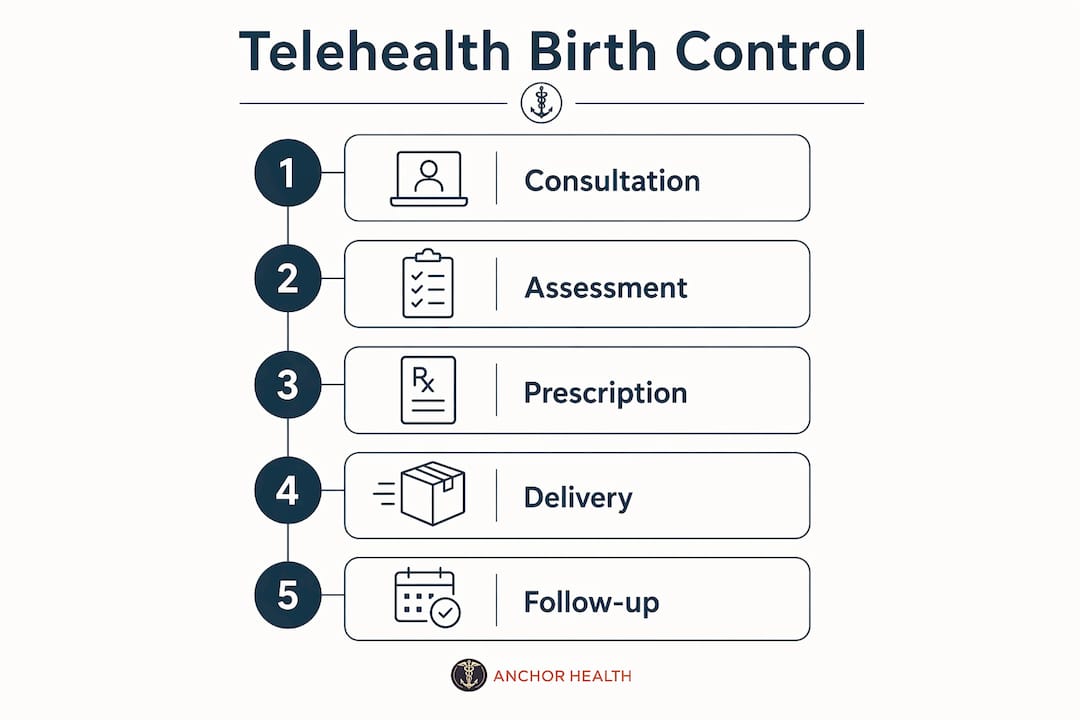
Here is how it typically works:
- Complete a secure online intake form covering your health history, current medications, and contraceptive goals
- Submit a recent blood pressure reading (within the past 12 months) from a home monitor or pharmacy kiosk, required before hormonal birth control can be prescribed due to cardiovascular considerations
- A licensed provider reviews your information, usually an MD, DO, or Nurse Practitioner, and may follow up with clarifying questions via secure message or video
- Discuss your preferences openly, including past contraceptive use, side effect concerns, and lifestyle factors
- Receive your prescription sent directly to a local pharmacy for same-day pickup or shipped to your home, often within a few days of your virtual consult
Telehealth birth control consultations typically serve adult patients of reproductive age. The range of methods available online covers most of what a traditional office visit would offer, with one key exception: long-acting devices like IUDs and implants require in-person insertion and cannot be prescribed remotely. For everything else, a virtual birth control consultation gives you real clinical care without the logistical friction.
How do you discuss birth control options through telehealth?
Telehealth birth control services in the US operate through a handful of well-established platforms, each with its own coverage area, cost structure, and clinical approach. The table below compares three notable options.

| Feature | Walgreens Virtual Care | Planned Parenthood Direct | Myanchorhealthpc (Anchor Health) |
|---|---|---|---|
| Provider overview | Retail pharmacy-backed telehealth service offering women’s health consultations | App-based reproductive health service from a nationally recognized organization | Maryland-based primary care telehealth practice using the Anchored Care℠ᴵᴾ model |
| Available birth control methods | Combination pills, progestin-only pills, patches, rings, some non-hormonal options | Pill (combination and progestin-only), patch, ring | Hormonal and non-hormonal options discussed within a full primary care framework |
| Cost and insurance | Consultation fees typically run in a moderate range; insurance often reduces prescription costs; FSA/HSA eligible | Accepts most insurance; uninsured patients can pay out of pocket; costs vary by state | Accepts insurance; membership options available for ongoing care |
| State availability | Available in select states; state regulations affect which medications can be prescribed | Available in select states; pills offered may vary by state | Currently serving Maryland via telehealth |
| Consultation process | Async intake form plus provider review; follow-up by secure message | Complete health questionnaire via app; provider reviews and messages if clarification needed; video appointments available | Secure video visits with a consistent provider; relationship-based care model |
| Refill and follow-up | Ongoing refills and side-effect consultations available without in-person visits | Automatic refill sign-up available; prescription sent to pharmacy or mailed | Ongoing contraceptive management as part of primary care continuity |
| Security and licensing | HIPAA-compliant encrypted platform; licensed MDs, DOs, and NPs | HIPAA-compliant; Planned Parenthood-licensed clinicians | HIPAA-compliant secure video visits; licensed primary care clinicians |
A few things worth noting. Walgreens Virtual Care suits patients who want a quick, transactional consultation tied to an existing pharmacy relationship. Planned Parenthood Direct excels at reproductive health specifically, with a strong track record in telehealth care access for patients without insurance. Myanchorhealthpc takes a different approach entirely: birth control is part of a broader primary care relationship, which matters when your contraceptive needs intersect with other health concerns like metabolic health, mental wellness, or postpartum recovery.

State law shapes what any of these providers can offer you. Pharmacy partnerships and state licenses directly influence which medications are available and whether a provider can serve your zip code at all.
What birth control methods can you get through telehealth?
Most hormonal contraceptives are fully accessible through a virtual birth control consultation. The FDA-approved options span a wide range of delivery methods, and telehealth providers can prescribe the majority of them remotely.
Hormonal methods available via telehealth:
- Combination pills (estrogen and progestin): the most commonly prescribed option, available in many formulations
- Progestin-only pills (the “mini-pill”): suitable for patients who cannot use estrogen, including those who are breastfeeding
- Contraceptive patch: worn on the skin and changed weekly, prescribed and mailed or sent to pharmacy
- Vaginal ring: inserted monthly, prescription sent the same way as pills and patches
Non-hormonal options:
- Diaphragm: a barrier method that some telehealth providers can prescribe, though fitting guidance may require follow-up
What telehealth cannot provide:
- IUDs (hormonal or copper): require in-person insertion by a trained clinician
- Implants (subdermal): also require in-person placement
The CDC’s contraception guidance outlines medical eligibility criteria that licensed telehealth providers use to determine which method fits your health profile. A provider reviewing your intake form will assess factors like blood pressure, migraine history, smoking status, and prior contraceptive experience before recommending a method. That clinical review is what separates a telehealth consultation from simply ordering medication online.
Pro Tip: If you have a history of blood clots, migraines with aura, or uncontrolled hypertension, mention these clearly in your intake form. They directly affect which hormonal methods are safe for you, and a thorough provider will ask about them anyway.
What does telehealth birth control actually cost?
Telehealth consultation fees for birth control typically run around $30–$40, separate from the cost of the medication itself. That fee structure is generally lower than a traditional office visit copay, and it does not require taking time off work or arranging childcare.
Here is how the cost picture breaks down:
- With insurance: most health insurance plans cover telehealth consultations, and prescription contraceptives are often covered at no additional cost under the Affordable Care Act’s preventive care mandate
- FSA and HSA accounts: consultation fees and prescription costs are typically eligible expenses, reducing your effective out-of-pocket cost
- Without insurance: you pay the consultation fee directly, then the medication cost at the pharmacy or through mail-order; some providers offer sliding-scale fees or reduced-cost programs
- Medication costs: vary by method and whether you use a generic; combination pills in generic form are often available for very low monthly costs at major pharmacy chains
Transparency about pricing before you commit matters. Reputable telehealth services will show you estimated costs during the intake process, not after. If a platform is vague about fees until after you have submitted your health information, that is worth pausing on.
What happens during a telehealth birth control consultation?
A telehealth birth control appointment follows a clear, predictable sequence. Knowing what to expect makes the process faster and less stressful.
Before your appointment:
- Create an account on the telehealth platform and complete a secure health history intake form
- Gather a recent blood pressure reading (within the past 12 months); you can use a home cuff or a pharmacy kiosk, and you will need to submit it with your name and the date it was taken
- Note any current medications, allergies, and your contraceptive history, including methods you have tried and any side effects you experienced
During the consultation:
- A licensed provider reviews your intake form; depending on the platform, this may be asynchronous (they review and respond via secure message) or synchronous (a live video call)
- The provider may ask follow-up questions about your health history, preferences, or goals
- You discuss which methods align with your lifestyle, health status, and any concerns you have about side effects or effectiveness
- The provider makes a clinical determination and, if appropriate, authorizes a prescription
After the consultation:
- Your prescription is sent to your chosen local pharmacy for pickup, or to a mail-order service for home delivery
- Patients often receive medications within days after a virtual consult, with discreet packaging standard for mail delivery
- Follow-up is available for side-effect questions, method adjustments, or refill requests without scheduling another full appointment
The telehealth prescription process mirrors the clinical rigor of an in-person visit. The difference is that it fits into your schedule, not the other way around.
How do you choose the right telehealth provider for birth control?
Not every telehealth service is the same, and the right fit depends on more than just which platform has the slickest app. Here is what to evaluate before you commit:
- State licensing: confirm the provider is licensed to prescribe in your state; availability varies, and some platforms serve only a subset of states
- Methods offered: if you are interested in the patch or ring rather than pills, verify the provider prescribes those specifically, since not all platforms offer every method
- Appointment flexibility: some services are fully asynchronous (form-based, no live call), while others offer video visits; choose based on how much direct interaction you want with your provider
- Insurance compatibility: check whether the platform accepts your specific plan before you start the intake process, not after
- Privacy and security: look for explicit HIPAA compliance, encrypted intake forms, and a clear data privacy policy; secure telehealth platforms use encrypted channels for all communication
- Continuity of care: if you want the same provider managing your birth control alongside your broader health, a primary care telehealth practice offers something a single-service app cannot
Telehealth removes real barriers for patients who face transportation challenges, inflexible work schedules, or limited local provider access. That equity dimension matters, particularly for patients in rural areas or those managing childcare alongside their own healthcare needs.
How Myanchorhealthpc approaches birth control care
Myanchorhealthpc operates on the Anchored Care℠ᴵᴾ model, which means birth control is not a one-time transaction. It is part of an ongoing, relationship-based conversation with a consistent licensed provider who knows your full health picture.
That distinction has real clinical value. A provider who also manages your mental health, metabolic health, or postpartum recovery can make contraceptive recommendations that account for the whole picture, not just the single question you asked today. Combination pills, for example, interact with certain antidepressants and metabolic medications in ways that a siloed reproductive health app may not catch.
Myanchorhealthpc conducts all consultations through secure, encrypted video visits that meet HIPAA standards. Intake forms are protected, and patient records remain confidential throughout the prescription and follow-up process. For patients who want gynecological primary care woven into their ongoing health management, that level of continuity is what sets this model apart from single-service telehealth apps.
Membership options are available for patients who want enhanced access, including priority scheduling and more direct communication with their provider between visits. For ongoing contraceptive management, that kind of consistent access makes a practical difference.
Pro Tip: When you start with a primary care telehealth provider rather than a single-service app, bring a list of all current medications and supplements to your first visit. Contraceptive choices interact with more medications than most patients realize, and your provider needs the full picture.
Key Takeaways
Telehealth makes it genuinely practical to discuss, select, and manage birth control with a licensed clinician remotely, provided you choose a provider licensed in your state and come prepared with your health history and a recent blood pressure reading.
| Point | Details |
|---|---|
| Blood pressure is required | Submit a reading from the past 12 months before any hormonal method can be prescribed. |
| Consultation costs around $30–$40 | Insurance often covers this fee; FSA and HSA accounts are typically eligible too. |
| IUDs and implants need in-person care | Long-acting reversible contraceptives cannot be prescribed or inserted via telehealth. |
| State law shapes your options | Licensing and pharmacy partnerships determine which methods and providers are available where you live. |
| Myanchorhealthpc offers relationship-based care | Birth control is managed within a full primary care framework, not as a standalone service. |
Why telehealth birth control is better than most people expect
The conventional wisdom treats telehealth birth control as a convenience play, a shortcut for busy people who just want to skip the waiting room. That framing undersells what is actually happening.
The patients who benefit most from virtual birth control consultations are not necessarily the ones who find in-person visits inconvenient. They are the ones for whom in-person visits were genuinely inaccessible: patients in rural counties with no OB-GYN within 50 miles, patients working two jobs with no flexibility for a Tuesday afternoon appointment, patients who delayed contraceptive care for months because the logistics never lined up. Telehealth improves health equity by reaching these patients, not just the ones who already had access and wanted something faster.
There is also a privacy dimension that does not get enough attention. For patients in households where reproductive health decisions are sensitive, or in communities where visiting a clinic carries social stigma, the ability to complete a consultation privately from a personal device changes the calculation entirely. Discreet packaging and direct pharmacy delivery are not minor conveniences. For some patients, they are the reason care happens at all.
What I would push back on is the assumption that telehealth birth control is inherently less thorough than an in-person visit. A well-designed telehealth consultation, with a proper intake form, a blood pressure requirement, and a licensed clinician reviewing the full health history, meets the same clinical standard. The gap is not in quality. It is in which platforms actually hold themselves to that standard versus which ones treat the intake form as a formality. Choose accordingly.
Myanchorhealthpc brings primary care continuity to birth control
Most telehealth birth control services give you a prescription and move on. Myanchorhealthpc does something different: it places your contraceptive care inside a full primary care relationship, so the provider prescribing your birth control is the same one managing your overall health.
For patients in Maryland, that means secure video visits with a licensed clinician who knows your health history, tracks how your chosen method is working over time, and can adjust your care when your circumstances change, whether that is a new medication, a health transition, or a shift in your reproductive goals. The Anchored Care℠ᴵᴾ model is built around continuity, not episodic transactions.
Membership options make ongoing contraceptive management practical, with priority access and direct provider communication between scheduled visits. Insurance is accepted, and the intake process is fully HIPAA-compliant from the first form to the final prescription.
If you are ready to discuss your birth control options with a provider who will actually know you, choose telehealth primary care that goes beyond a single prescription. Visit Myanchorhealthpc to book your first secure video visit and start a care relationship built to last.
Recommended
- Postpartum Care Telehealth Benefits for New Mothers
- How the Telehealth Prescription Process Works
- How Telehealth Works for College Students in 2026
- How Telehealth Removes Barriers for Young Patients
Blog & Information Disclaimer
Last Updated: May 23, 2026
The information provided on the Anchor Health website (https://myanchorhealthpc.com/), including but not limited to blog posts, articles, newsletters, graphics, and other materials (collectively, the "Content"), is for general informational and educational purposes only.
By accessing and using this website, you acknowledge and agree to the following terms and conditions:
The Content on this website is not intended to be a substitute for professional medical advice, diagnosis, or treatment. Always seek the advice of your physician, nurse practitioner, or other qualified health provider with any questions you may have regarding a medical condition. Never disregard professional medical advice or delay in seeking it because of something you have read on this website.
Reading, interacting with, or sharing the Content on this website does not establish a patient-provider relationship between you and Anchor Health or any of its clinicians, including Paule Valery Joseph, PhD, MBA, CRNP, FAAN. A formal patient-provider relationship is only established after you have completed the formal intake process, signed our clinical consent forms, and participated in a secure clinical consultation.
If you are experiencing a medical emergency, call 911 or seek emergency medical services immediately.
Anchor Health is a primary care practice and does not provide emergency or crisis intervention services through its website or blog.
While Anchor Health strives to provide thoughtful, evidence-based information grounded in our Anchored Care℠ model, healthcare is a rapidly evolving field. We make no representations or warranties, express or implied, about the completeness, accuracy, reliability, or suitability of the information contained in the Content. Any reliance you place on such information is strictly at your own risk.
Anchor Health is a telehealth practice providing services to patients physically located within the state of Maryland. The information provided on this blog is intended for residents of Maryland and is governed by the laws and regulations of that state. Accessing this information from outside of Maryland does not imply that our clinicians are licensed to practice medicine or provide consultations in your jurisdiction.
Content related to Weight & Metabolic Health, including discussions of GLP-1 medications or other medical therapies, is provided for educational context regarding our clinical approach. Prescriptions and specific medical recommendations are only made following a comprehensive clinical evaluation, diagnostic testing, and shared decision-making within a formal patient-provider relationship.
This website may contain links to external websites that are not provided or maintained by or in any way affiliated with Anchor Health. Please note that Anchor Health does not guarantee the accuracy, relevance, timeliness, or completeness of any information on these external websites.
To the fullest extent permitted by law, Anchor Health, its owners, and its employees shall not be liable for any direct, indirect, incidental, consequential, or punitive damag
Related posts