One Clinician, Ongoing Care: Telehealth Menopause Therapy for Women

Yes, telehealth can deliver guideline-concordant menopause hormone therapy for many symptomatic women, once a clinician reviews your history and confirms you’re a good candidate. Most programs pair a live virtual visit with a personalized prescription plan, often shipped directly to your door. Telehealth isn’t the right path for everyone, though. Unexplained bleeding, certain cancer histories, or clotting risks usually mean an in-person workup first.
TL;DR:
- Women under 60 or within 10 years of menopause are most suitable for telehealth hormone therapy, with safety strongly supported by medical guidelines.
- Unexplained vaginal bleeding, lack of recent mammograms, or personal clotting risks typically require in-person evaluation before starting therapy.
- Choosing a provider with menopause-specific training, continuity of care, and transparent policies ensures safer, more effective long-term management.
- Symptom relief from hormone therapy generally appears within four to six weeks, but ongoing follow-up is crucial for dose adjustments and safety monitoring.
- Prioritize providers who offer consistent, personalized care over speed or convenience to better manage the dynamic hormonal changes during menopause.
Table of Contents
- How Does Menopause Hormone Therapy Telehealth Actually Work?
- Which Symptoms Does Hormone Therapy Actually Treat?
- Is Hormone Therapy Safe to Manage Through Telehealth?
- How Do You Choose a Trustworthy Telehealth Provider?
- How Does Anchor Health Support Menopause Care Through Telehealth?
- Telehealth Menopause Care: A Realistic Perspective
- Ready to Talk to a Clinician About Your Symptoms?
- Sources
How Does Menopause Hormone Therapy Telehealth Actually Work?
A telehealth menopause visit follows a fairly consistent path, whether you’re managing hot flashes at 51 or perimenopausal mood swings at 46. Understanding each step ahead of time helps you show up prepared and get to relief faster.
- Intake questionnaire. You’ll answer detailed questions about your medical history, current medications, family history of clotting or breast cancer, and the specific symptoms bothering you most. This isn’t a formality. It’s what allows your clinician to rule out contraindications before you ever get on a call.
- Live clinician visit. A physician, nurse practitioner, or physician assistant reviews your intake and talks with you directly, usually for 20 to 30 minutes. This is where a real conversation happens, not a rubber stamp on a form.
- Treatment plan formation. Your clinician decides between estrogen-only therapy (if you’ve had a hysterectomy) or a combined estrogen-progesterone regimen, and picks a delivery method (patch, pill, or gel) suited to your symptoms and risk profile. Labs aren’t always required to start, though your clinician may order them if your history warrants it.
- Prescription fulfillment. Depending on the platform, your prescription ships directly or routes to a local pharmacy for pickup, and refill workflows typically run on a 30 to 90 day cadence.
- Follow-up. Expect a check-in around six to eight weeks after starting treatment to assess symptom relief and adjust dosing if needed.
Which Symptoms Does Hormone Therapy Actually Treat?
Hormone therapy is built for a specific, recognizable set of symptoms, not vague fatigue or general “off” feelings. If your symptoms fall on this list, you’re a strong candidate for evaluation:
- Hot flashes and night sweats that disrupt sleep or daily function
- Vaginal dryness or discomfort during intimacy
- Sleep disturbances tied to hormonal shifts
- Mood changes, irritability, or new anxiety during perimenopause
Symptom relief often shows up within weeks, not months. The FDA notes that hormone replacement therapies commonly ease bothersome menopausal symptoms with relief frequently reported within the first four to six weeks of starting treatment.
Who tends to qualify? Generally, healthy women under 60 or within 10 years of their final period, without contraindications like active breast cancer or unexplained vaginal bleeding. If you’ve had a hysterectomy, your clinician will likely prescribe estrogen-only therapy since there’s no uterine lining left to protect.
Is Hormone Therapy Safe to Manage Through Telehealth?
Safety is the question every woman asks before she books a virtual visit, and it deserves a direct answer grounded in what the major medical bodies actually say.
The Menopause Society’s position paper concludes that menopausal hormone therapy is safe and effective for the overwhelming majority of healthy women under age 60 or within 10 years of menopause onset.
That age and timing window matters more than almost anything else in this conversation. Starting hormone therapy closer to menopause onset generally carries a more favorable risk profile than starting it a decade or more later.
Telehealth clinicians are trained to screen for the situations that call for a pause and a referral rather than a prescription. Common flags include:
- Unexplained vaginal bleeding, which needs evaluation before any hormone therapy starts
- No recent mammogram in women who are due for one
- A personal history of blood clots, stroke, or hormone-sensitive cancers
- Uncontrolled hypertension or liver disease
For hysterectomy patients, the prescribing logic shifts in a specific way: estrogen-only regimens are standard because progesterone’s main job is protecting the uterine lining, and that protection becomes unnecessary once the uterus is gone. A telehealth clinician who understands this distinction, rather than defaulting to a one-size-fits-all prescription, is doing the job correctly.
How Do You Choose a Trustworthy Telehealth Provider?
Not every telehealth menopause service operates the same way, and the differences matter more than glossy marketing suggests. Formal menopause training remains uncommon even among general practitioners, which makes credential-checking a genuinely practical step, not a box to check for its own sake.
Before you commit to a platform, look for these signals:
- Board certification and menopause-specific training, not just a general telehealth license
- A live clinician visit, not an algorithm-only intake that auto-generates a prescription
- Care continuity, including ongoing messaging access and scheduled follow-ups rather than a single transactional visit
- Integrated lifestyle support, since some models pair medical hormone therapy with registered dietitians or behavioral health for a fuller picture of your metabolic and emotional health during the transition
- Transparent pricing and insurance acceptance, spelled out before you enter payment information
- Clear pharmacy and refill policies, so you know exactly how and when your prescription arrives
Pro Tip: Ask directly during your first visit: “What happens if my symptoms don’t improve after six weeks?” A provider with a real follow-up protocol will have a specific answer, not a vague reassurance.
Care models vary by design. Some prioritize speed and medication optimization; others build around sustained clinician relationships and whole-person support. Decide which one actually fits how you want to be cared for before you sign up.
How Does Anchor Health Support Menopause Care Through Telehealth?
The care model Anchored Care℠ᴵᴾ is built around a simple premise: menopause isn’t a single appointment problem, it’s a multi-year transition that deserves a consistent provider who knows your history. That continuity shapes how women’s hormonal health gets handled inside the practice.
Here’s what that looks like in practice:
- Continuity over one-off visits. You see a consistent provider across your perimenopause and menopause years, rather than a different clinician each time you log in.
- Women’s hormonal health folded into primary care, so symptom management connects to your broader health picture, not an isolated hormone script.
- Insurance acceptance and membership options, giving you flexibility between standard co-pay visits and enhanced access for more frequent check-ins.
- Telehealth-only delivery within Maryland, with secure video visits designed to feel like an actual conversation rather than a rushed transaction.
- Coordinated prescription and follow-up processes, so a treatment plan doesn’t end the moment your visit does.
That combination, a familiar provider plus evidence-based prescribing, is what guideline-concordant menopause care is supposed to look like when it’s done through a screen.
Telehealth Menopause Care: A Realistic Perspective
The conventional advice on telehealth menopause care tends to focus on speed: how fast you can get a prescription, how few clicks it takes, which is why understanding why a fast Virginia medical cannabis certification can be more patient-centered than a slow one offers useful insights into telehealth operations and patient access. That framing misses what actually determines whether hormone therapy works long term, which is whether someone is watching your response to it over months, not just approving it once.
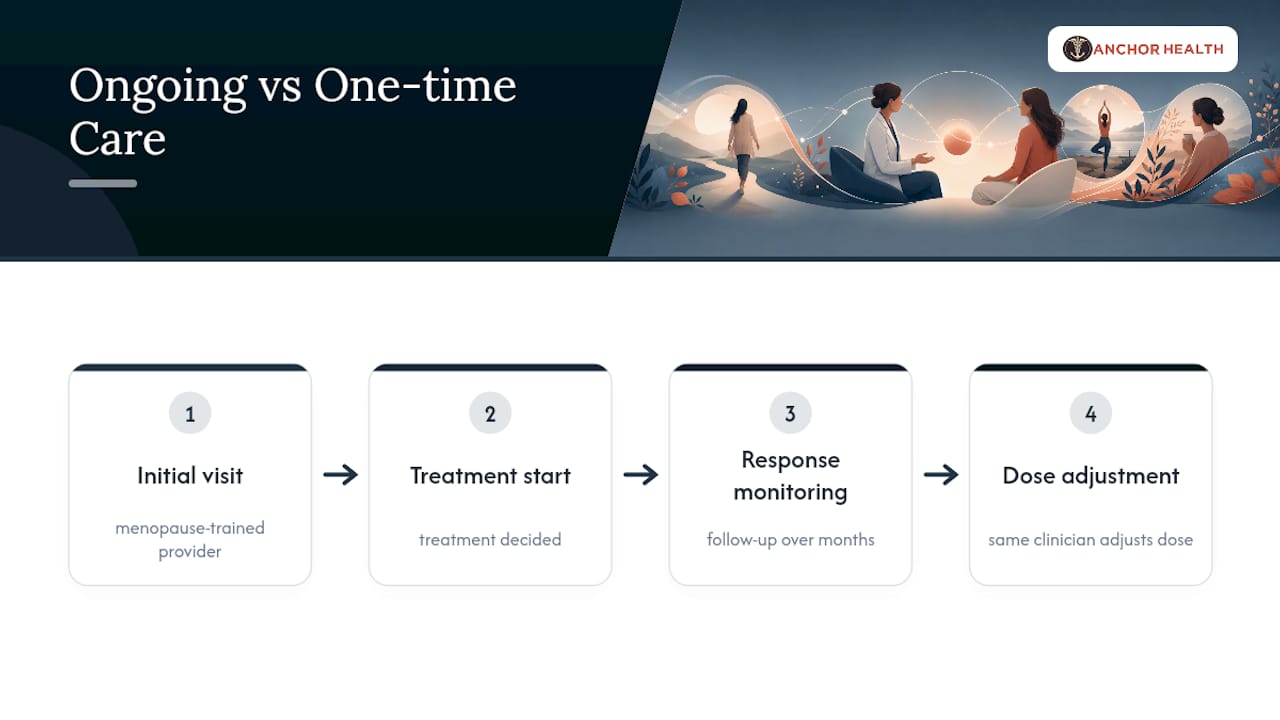
I’d argue the real differentiator isn’t access, since nearly every platform now offers a same-week visit. It’s whether the clinician you see today is the same one adjusting your dose in eight weeks. Women’s symptoms shift as they move through perimenopause into full menopause, and a provider without that history is starting over each time.
If you’re evaluating options, prioritize continuity and credential depth over speed of intake. A slightly slower first appointment with a menopause-trained clinician who will actually follow your case beats a same-day prescription from someone you’ll never see again.
— Paule
Ready to Talk to a Clinician About Your Symptoms?
If hot flashes, disrupted sleep, or mood changes have been running your life lately, the fastest way forward is a real conversation, not another search session. This service offers a consistent clinician who reviews your full history and stays with you through dosage adjustments, not just a one-time prescription drop.
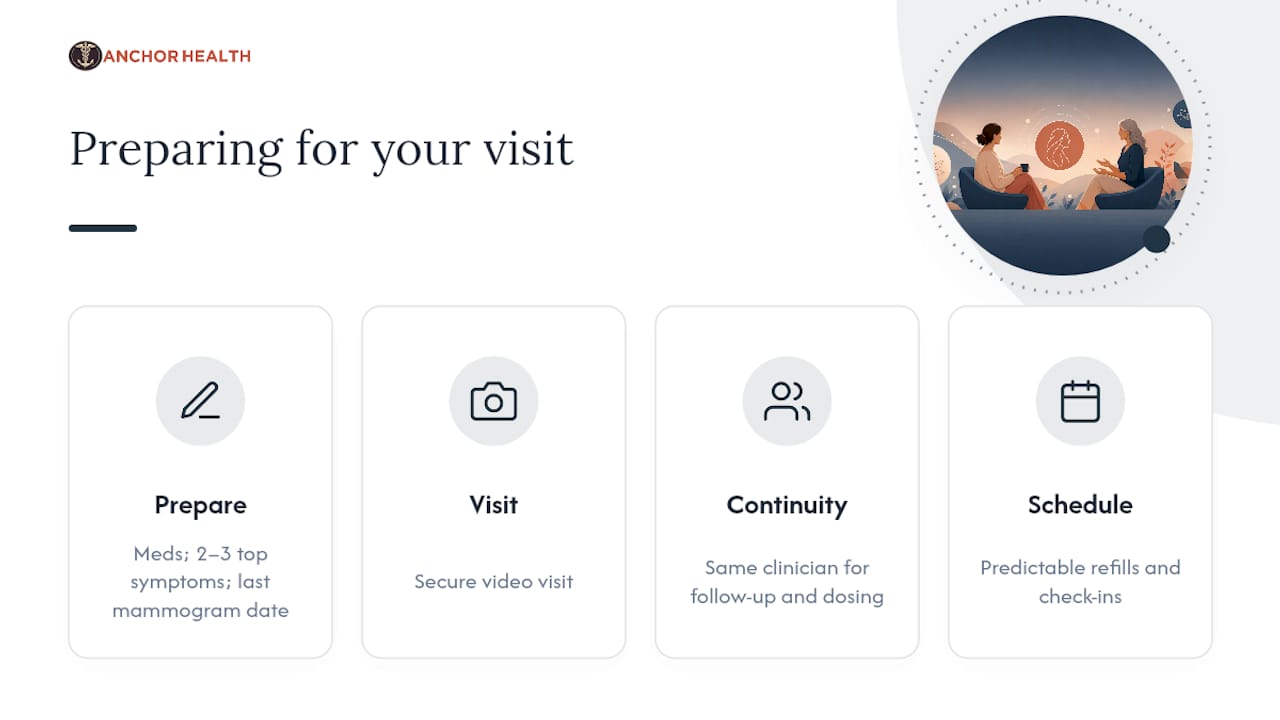
Before you book, gather a short list: your current medications, two or three specific symptoms bothering you most, and the date of your last mammogram or pelvic exam if you have one on file. Visits run through secure video and offer options for women who want more frequent check-ins during the transition. Once your plan is set, refills and follow-up are handled on a predictable schedule instead of a fresh scramble each time.
Ready to see what a full evaluation looks like? Explore how Anchor Health manages women’s hormonal health and schedule your first visit today.
This article is general information, not a substitute for advice from a qualified doctor. Consult a qualified healthcare professional about your own circumstances before acting on anything here.
Sources
- The Menopause Society position paper on MHT
- Hormone replacement therapies can help women with bothersome menopausal symptoms — FDA
- Hormone therapy for menopause symptoms — Cleveland Clinic
Recommended
- Choosing Perimenopause Telehealth Care That Actually Fits
- How to Balance Caregiving Work with Telehealth
- What Gynecological Primary Care Includes for Women
- Postpartum Care Telehealth Benefits for New Mothers
Blog & Information Disclaimer
Last Updated: May 23, 2026
The information provided on the Anchor Health website (https://myanchorhealthpc.com/), including but not limited to blog posts, articles, newsletters, graphics, and other materials (collectively, the "Content"), is for general informational and educational purposes only.
By accessing and using this website, you acknowledge and agree to the following terms and conditions:
The Content on this website is not intended to be a substitute for professional medical advice, diagnosis, or treatment. Always seek the advice of your physician, nurse practitioner, or other qualified health provider with any questions you may have regarding a medical condition. Never disregard professional medical advice or delay in seeking it because of something you have read on this website.
Reading, interacting with, or sharing the Content on this website does not establish a patient-provider relationship between you and Anchor Health or any of its clinicians, including Paule Valery Joseph, PhD, MBA, CRNP, FAAN. A formal patient-provider relationship is only established after you have completed the formal intake process, signed our clinical consent forms, and participated in a secure clinical consultation.
If you are experiencing a medical emergency, call 911 or seek emergency medical services immediately.
Anchor Health is a primary care practice and does not provide emergency or crisis intervention services through its website or blog.
While Anchor Health strives to provide thoughtful, evidence-based information grounded in our Anchored Care℠ model, healthcare is a rapidly evolving field. We make no representations or warranties, express or implied, about the completeness, accuracy, reliability, or suitability of the information contained in the Content. Any reliance you place on such information is strictly at your own risk.
Anchor Health is a telehealth practice providing services to patients physically located within the state of Maryland. The information provided on this blog is intended for residents of Maryland and is governed by the laws and regulations of that state. Accessing this information from outside of Maryland does not imply that our clinicians are licensed to practice medicine or provide consultations in your jurisdiction.
Content related to Weight & Metabolic Health, including discussions of GLP-1 medications or other medical therapies, is provided for educational context regarding our clinical approach. Prescriptions and specific medical recommendations are only made following a comprehensive clinical evaluation, diagnostic testing, and shared decision-making within a formal patient-provider relationship.
This website may contain links to external websites that are not provided or maintained by or in any way affiliated with Anchor Health. Please note that Anchor Health does not guarantee the accuracy, relevance, timeliness, or completeness of any information on these external websites.
To the fullest extent permitted by law, Anchor Health, its owners, and its employees shall not be liable for any direct, indirect, incidental, consequential, or punitive damag
Related posts