Build Healthy Habits With Telehealth Support: A Patient Guide

Yes — telehealth can support lasting healthy habits by combining scheduled clinician visits, remote monitoring, and digital coaching into one consistent, accessible framework. The most important next step you can take right now is to schedule a focused telehealth visit with a primary care clinician or registered dietitian, bring a short log of your current habits, and identify one measurable goal before that first session.
Here is what telehealth makes possible for habit change:
- Video visits with your primary care clinician (PCP), registered dietitian (RD), or licensed health coach for goal-setting and personalized planning
- Secure messaging between appointments to report progress, ask questions, and stay accountable
- Remote patient monitoring that connects smart scales, glucometers, or activity trackers directly to your care team for objective tracking
Pro Tip: Before your first telehealth visit, spend five minutes writing down your single biggest habit barrier. Clinicians consistently say this one piece of information shapes the entire first session.
Table of Contents
- What “telehealth support for healthy habits” actually includes
- How telehealth helps behavior change — evidence-based benefits
- What a typical telehealth visit for habit-building looks like
- Step-by-step plan to set and sustain healthy habits with telehealth
- How to prepare for a telehealth visit focused on habit change
- What to expect: realistic timelines and how progress is tracked
- Technology, privacy, licensure, and insurance: U.S. consumer checks
- How Myanchorhealthpc approaches habit change via telehealth
- Key Takeaways
- A clinician’s perspective on telehealth and realistic habit change
- Myanchorhealthpc is ready to support your habit goals
- Recommended reading and sources
What “telehealth support for healthy habits” actually includes
Telehealth habit support is ongoing virtual care focused on lifestyle behaviors — nutrition, physical activity, sleep, and stress management — delivered through a combination of technology and trained clinicians. It is not a single app or a one-time consultation. It is a structured, repeating relationship.
The clinicians you might work with include:
- Primary care clinician (PCP): Reviews your medical history, manages medications, orders labs, and coordinates your overall care plan
- Registered dietitian (RD): Provides medical nutrition therapy via telehealth, including reviewing eating habits, setting nutrition goals, and follow-up counseling
- Licensed health coach: Focuses on behavioral strategies, motivation, and accountability between clinical visits
- Behavioral health specialist: Addresses mood, stress, and psychological factors that affect habit formation
“Telehealth enables video, phone, and secure messaging visits with Registered Dietitians; services include reviewing eating habits, setting nutrition goals, medical nutrition therapy, follow-up counseling, and remote monitoring.” — HHS Telehealth Guidance
Services are delivered through synchronous video or phone visits, asynchronous secure messaging, remote patient monitoring, and app-based coaching. A 2025 systematic review synthesizing 35 peer-reviewed studies identified three distinct digital coaching modalities: digital human coaching, AI-driven coaching, and hybrid models combining both. All three demonstrated feasibility and acceptability for supporting lifestyle change and chronic condition management.
The key distinction to keep in mind: evidence-based clinical services like RD medical nutrition therapy or PCP medication management are different from general wellness apps. Clinical services are delivered by credentialed professionals, often covered by insurance, and tied to your medical record.
How telehealth helps behavior change — evidence-based benefits
Convenience is the most obvious benefit, but continuity is the one that actually drives results. When you can see a specialist who is not available locally, check in weekly without driving anywhere, and message your care team between visits, the consistency required for real habit formation becomes far more achievable.
Key benefits backed by research:
- Accessibility: Telehealth reduces wait times for behavioral health and expands access in underserved or rural areas where specialists may not be available in person
- Continuity: Scheduled follow-ups and secure messaging keep you connected to your care team across weeks and months, not just during a single visit
- Privacy and comfort: Being at home often increases patient openness during sensitive conversations about diet, weight, or mental health, which can improve the quality of the clinical conversation
- Objective tracking: Remote monitoring shifts visits from subjective self-reports to real, device-generated data your clinician can act on
- Specialist access: You can work with an RD, health coach, or behavioral health specialist without being limited to providers within driving distance
Telehealth’s home-based setting often increases patient comfort and openness, which can improve the clinician–patient conversation about sensitive lifestyle topics.
The systematic review of digital health coaching found that both human and AI coaching showed positive impact on engagement and lifestyle outcomes. Hybrid approaches, which pair human oversight with daily digital prompts, preserve personalization while improving scalability — a practical option for patients who want structured accountability without waiting for the next scheduled visit.
What a typical telehealth visit for habit-building looks like
A well-structured telehealth habit visit follows a clear sequence: intake and history review, goal setting, personalized plan, and an agreed follow-up cadence. Your first visit is usually longer — expect 30–60 minutes — because the clinician needs your full picture before building a plan. Follow-up visits are typically 10–30 minutes and focus on reviewing progress and adjusting the plan.
“Telehealth is enabling the same thoughtful, personalized care as in-person visits for many routine and wellness needs, and as a way to keep regular contact with clinicians.” — Hopkins MD
Each team member handles a distinct role. Your PCP reviews your medical history, orders relevant labs, and manages any medications that support your goals (such as GLP-1 agents for metabolic health). Your RD addresses nutrition specifics and builds a medical nutrition therapy plan. A health coach focuses on behavioral strategies, habit stacking, and check-ins between clinical visits. If mood or stress is affecting your progress, a behavioral health specialist can address those factors within your primary care framework.
Remote monitoring and app connections add a layer of objectivity. When your smart scale or activity tracker feeds data directly to your clinician’s platform, your follow-up visit starts with real numbers rather than estimates. This makes brief follow-ups far more productive. For patients managing chronic disease through telehealth, this data integration is especially valuable for adjusting plans quickly.

Step-by-step plan to set and sustain healthy habits with telehealth
-
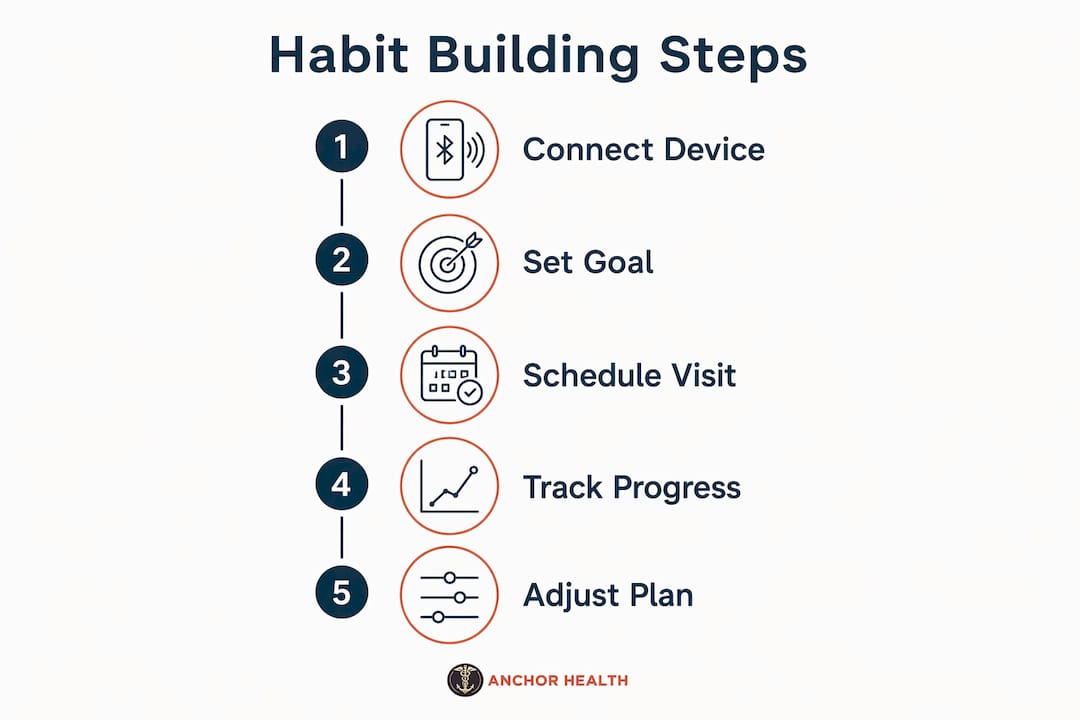
Start with a medical review and one SMART goal. Before committing to any habit, confirm with your PCP that the goal is appropriate for your current health status. A SMART goal is specific, measurable, achievable, relevant, and time-bound. “Walk 20 minutes five days a week for eight weeks” is a SMART goal. “Exercise more” is not. Use the guidance on setting health goals with a telehealth provider to frame your first conversation.
-
Set up objective measurements. Pair a daily habit log with at least one device metric — steps, sleep hours, weight, or fasting glucose. Clinicians routinely use a mix of device data and short patient-reported summaries to make quick, evidence-based adjustments during brief follow-ups.
-
Establish an intensive early phase. For the first four to eight weeks, schedule weekly or biweekly check-ins. Structured programs that use scheduled one-on-one sessions over several months with goal setting and follow-up accountability consistently outperform single-visit models.
-
Apply behavioral tactics between visits. Micro-goals (a five-minute walk before a larger one), implementation intentions (“When I finish dinner, I will log my meal”), habit stacking (attaching a new habit to an existing one), and small environmental changes all reinforce what you discuss with your clinician.
-
Choose your coaching modality deliberately. Human coaching offers depth and personalization; AI coaching offers daily availability and scalability; hybrid coaching combines both. If you want daily prompts with human oversight at key milestones, a hybrid model is worth asking about.
-
Taper to monthly check-ins once habits stabilize. After roughly three months of consistent behavior, most patients can shift from weekly to monthly visits while maintaining secure messaging for questions and small course corrections.
-
Prepare a brief data summary before every session. Three numbers and one barrier — that is all your clinician needs to make the follow-up productive. Knowing how to communicate your care needs before each visit saves time and sharpens the plan.
Pro Tip: Connect your monitoring device to your telehealth platform before your first visit, not after. Clinicians who can see your baseline data at intake build more accurate plans from day one.
How to prepare for a telehealth visit focused on habit change
Preparation is what separates a productive first visit from a generic one. Gather these before you log on:
- Habit logs: At least one week of food, sleep, and activity records — even rough notes count
- Medication list: All current prescriptions, supplements, and over-the-counter medications
- Lab results and device data: Recent bloodwork, weight history, glucose readings, or wearable data if available
- Barriers and goals: A short written list of what has stopped you before and what you most want to change
- Tech check: Camera, microphone, and internet connection tested; patient portal login confirmed; device data uploaded if your platform supports it
Use the first telehealth visit checklist to confirm you have covered the practical details.
Questions worth asking your clinician or coach:
- What specific metric will we track to measure progress on this goal?
- How often should we check in, and what is the best way to reach you between visits?
- Are there any red flags I should watch for and report immediately?
- Is my RD visit or health coaching covered by my insurance, and is there a membership option for ongoing support?
On insurance: confirm coverage for RD visits and health coaching before your first appointment. Many plans cover medical nutrition therapy for specific diagnoses, and some telehealth practices offer membership options that provide enhanced access and structured follow-up beyond standard fee-for-service visits.

What to expect: realistic timelines and how progress is tracked
Habit formation takes longer than most people expect, and clinical outcomes take longer still. Here is a realistic framework:
| Phase | Timeframe | What to Expect |
|---|---|---|
| Early behavior change | Weeks 2–6 | Consistency improves; initial habit cues and routines establish |
| Habit consolidation | ~3 months | Behaviors become more automatic; motivation dips are normal |
| Intermediate health markers | 3–6 months | Weight, fasting glucose, sleep quality begin to shift measurably |
| Clinical outcome changes | 6 months | A1c, lipid panels, blood pressure reflect sustained lifestyle change |
Clinicians track progress using a combination of patient-reported logs and remote monitoring data. At each follow-up, your care team will review consistency (days per week on target), objective device metrics (steps, sleep hours), intermediate health markers, and functional outcomes like energy and mood. SMART goals are re-evaluated at each milestone and adjusted when you plateau or when life circumstances change.
Escalate care when progress stalls for more than four weeks without a clear reason, when new symptoms appear, or when a medication adjustment may be needed. A good telehealth clinician will flag these moments proactively rather than waiting for you to raise them.
Technology, privacy, licensure, and insurance: U.S. consumer checks
Before you book, confirm these four things:
- HIPAA compliance: Verify that the platform uses secure, encrypted video and messaging. Ask directly: “Is this platform HIPAA-compliant?” A reputable provider will answer without hesitation.
- State licensure: Your clinician must be licensed in the state where you are located at the time of the visit, not where the practice is based. Ask about interstate care rules if you travel frequently.
- Insurance coverage: Confirm which services are covered under your plan. RD medical nutrition therapy is covered by many plans for specific diagnoses; health coaching coverage varies. Know your co-pay and whether a membership option exists for sustained follow-up.
- Platform compatibility: Test your device and internet connection before the first visit. Confirm the platform works on your phone or computer and that you know how to upload device data or lab results through the patient portal.
Telehealth also reduces reliance on emergency care by keeping patients connected to a consistent provider — a practical benefit worth factoring into your decision when comparing telehealth options.
This article provides general health information, not medical advice. Confirm coverage, licensure, and clinical recommendations with your provider or insurance plan for your specific situation.
How Myanchorhealthpc approaches habit change via telehealth
Myanchorhealthpc is a Maryland-based telehealth primary care practice that operates on the Anchored Care℠ᴵᴾ model — a relationship-based framework built around continuity, longer visits, and integrated follow-up rather than episodic care. For patients focused on habit change, that distinction matters because sustained behavior change requires a consistent provider who knows your history, not a rotating roster of clinicians.
Services relevant to habit formation include:
- Primary care visits for medical review, lab ordering, and medication management (including GLP-1 agents for metabolic health where appropriate)
- Women’s health across reproductive and menopause stages, where hormonal factors often intersect with sleep, weight, and energy habits
- Mental and emotional health support within primary care scope, addressing the mood and stress factors that derail habit formation
- Pediatric and adolescent care, supporting healthy habit development for younger patients and their families
- Weight and metabolic health management, with structured follow-up and device integration
The workflow follows a clear path: intake visit with full history review, personalized plan with measurable goals, scheduled follow-ups with messaging in between, and optional membership for enhanced access and accountability. Myanchorhealthpc accepts insurance, self-pay, and HSA/FSA funds. For patients who want structured, ongoing support, the membership option provides longer visits and more frequent follow-up than standard fee-for-service scheduling.
Families navigating habit change together can explore telehealth primary care options to understand how the model fits different ages and health goals.
Key Takeaways
Telehealth supports lasting habit change when used as a structured, ongoing accountability channel with scheduled visits, remote monitoring, and consistent follow-up rather than one-off consultations.
| Point | Details |
|---|---|
| Start with one SMART goal | Identify one specific, measurable habit target before your first telehealth visit and confirm it with your clinician. |
| Use objective data | Connect a monitoring device to your telehealth platform so your care team can review real numbers, not estimates. |
| Plan for 3+ months | Early behavior changes appear in weeks 2–6; habit consolidation takes roughly three months; clinical markers shift at 6 months. |
| Verify privacy and coverage | Confirm HIPAA compliance, state licensure, and insurance coverage for RD visits or coaching before booking. |
| Myanchorhealthpc’s Anchored Care℠ᴵᴾ | Offers relationship-based telehealth primary care in Maryland with structured follow-up, metabolic health management, and membership options for sustained habit support. |
A clinician’s perspective on telehealth and realistic habit change
The most common mistake patients make is treating a telehealth visit like a one-time consultation — they come in, get a plan, and then disappear until something goes wrong. Habit formation does not work that way. The research on digital health coaching is clear that structured, repeating contact is what separates programs that produce lasting change from those that produce a good first week.
What I see most often as barriers: technology lapses (a device that was never connected, a portal login that was never set up), motivation dips around weeks three and four when the novelty wears off, and goals that were too large to begin with. The fix for all three is the same — smaller goals, a confirmed tech setup before the first visit, and a scheduled follow-up on the calendar before you leave the first session. Accountability does not happen by accident.
Telehealth is genuinely well-suited to habit support because it removes the friction of travel and scheduling. But it works best when you treat each visit as a structured accountability checkpoint, not a casual check-in. Come prepared, bring your data, and be honest about what is not working. That is the conversation that moves the needle.
Myanchorhealthpc is ready to support your habit goals
Consistent, relationship-based primary care is the foundation most habit-change programs are missing. Myanchorhealthpc provides telehealth primary care visits in Maryland with the time and structure to actually build a personalized plan — not a generic handout, but a goal-specific roadmap reviewed at every follow-up.
Your first visit covers a full medical review, goal-setting, and a measurement plan. Follow-up visits track your progress using both your reported logs and any device data you connect. For patients who want sustained support, the membership option provides enhanced access, longer visits, and more frequent check-ins. Myanchorhealthpc accepts insurance, self-pay, and HSA/FSA funds, so coverage options are flexible.
If metabolic health, weight management, or women’s health are part of your habit goals, those are areas where the practice has particular depth. Patients managing blood sugar alongside lifestyle changes can find specific guidance on diabetes care through telehealth.
Ready to start? Set health goals with a telehealth provider and book your first focused habit-change visit with Myanchorhealthpc today.
Recommended reading and sources
These resources are worth bookmarking and bringing to your first telehealth visit:
- HHS Telehealth Nutrition Guidance — The U.S. Department of Health and Human Services explains exactly what nutrition services RDs can deliver virtually, including medical nutrition therapy and remote monitoring. Share this with your clinician if you want to discuss RD referral.
- Systematic Review of Digital Health Coaching Modalities (PMC) — A 35-study peer-reviewed synthesis on human, AI, and hybrid coaching in digital health interventions. Useful background if you want to understand the evidence behind different coaching formats.
- Telehealth and Personal Wellness — TAFA — Telehealth Access for America’s overview of how virtual care improves access to behavioral health and wellness services.
- How to Set Health Goals With a Telehealth Provider — Myanchorhealthpc’s practical guide to translating your intentions into SMART targets your care team can track.
- First Telehealth Visit Checklist — A step-by-step preparation checklist from Myanchorhealthpc to make your first visit as productive as possible.
- Behavioral health support for habit change — For patients interested in adjunct behavioral approaches alongside clinical care, online hypnotherapy appointments are available nationwide through Kirk Hoffman CCHt.
Bring one or two of these links to your first telehealth visit as conversation starters. Clinicians appreciate patients who have done their homework — it shortens the time spent on basics and gets you to a personalized plan faster.
Recommended
- How to Set Health Goals With a Telehealth Provider
- How to Communicate Care Needs to Your Telehealth Provider
- How to Balance Caregiving Work with Telehealth
Blog & Information Disclaimer
Last Updated: May 23, 2026
The information provided on the Anchor Health website (https://myanchorhealthpc.com/), including but not limited to blog posts, articles, newsletters, graphics, and other materials (collectively, the "Content"), is for general informational and educational purposes only.
By accessing and using this website, you acknowledge and agree to the following terms and conditions:
The Content on this website is not intended to be a substitute for professional medical advice, diagnosis, or treatment. Always seek the advice of your physician, nurse practitioner, or other qualified health provider with any questions you may have regarding a medical condition. Never disregard professional medical advice or delay in seeking it because of something you have read on this website.
Reading, interacting with, or sharing the Content on this website does not establish a patient-provider relationship between you and Anchor Health or any of its clinicians, including Paule Valery Joseph, PhD, MBA, CRNP, FAAN. A formal patient-provider relationship is only established after you have completed the formal intake process, signed our clinical consent forms, and participated in a secure clinical consultation.
If you are experiencing a medical emergency, call 911 or seek emergency medical services immediately.
Anchor Health is a primary care practice and does not provide emergency or crisis intervention services through its website or blog.
While Anchor Health strives to provide thoughtful, evidence-based information grounded in our Anchored Care℠ model, healthcare is a rapidly evolving field. We make no representations or warranties, express or implied, about the completeness, accuracy, reliability, or suitability of the information contained in the Content. Any reliance you place on such information is strictly at your own risk.
Anchor Health is a telehealth practice providing services to patients physically located within the state of Maryland. The information provided on this blog is intended for residents of Maryland and is governed by the laws and regulations of that state. Accessing this information from outside of Maryland does not imply that our clinicians are licensed to practice medicine or provide consultations in your jurisdiction.
Content related to Weight & Metabolic Health, including discussions of GLP-1 medications or other medical therapies, is provided for educational context regarding our clinical approach. Prescriptions and specific medical recommendations are only made following a comprehensive clinical evaluation, diagnostic testing, and shared decision-making within a formal patient-provider relationship.
This website may contain links to external websites that are not provided or maintained by or in any way affiliated with Anchor Health. Please note that Anchor Health does not guarantee the accuracy, relevance, timeliness, or completeness of any information on these external websites.
To the fullest extent permitted by law, Anchor Health, its owners, and its employees shall not be liable for any direct, indirect, incidental, consequential, or punitive damag
Related posts