How to Set Health Goals With a Telehealth Provider

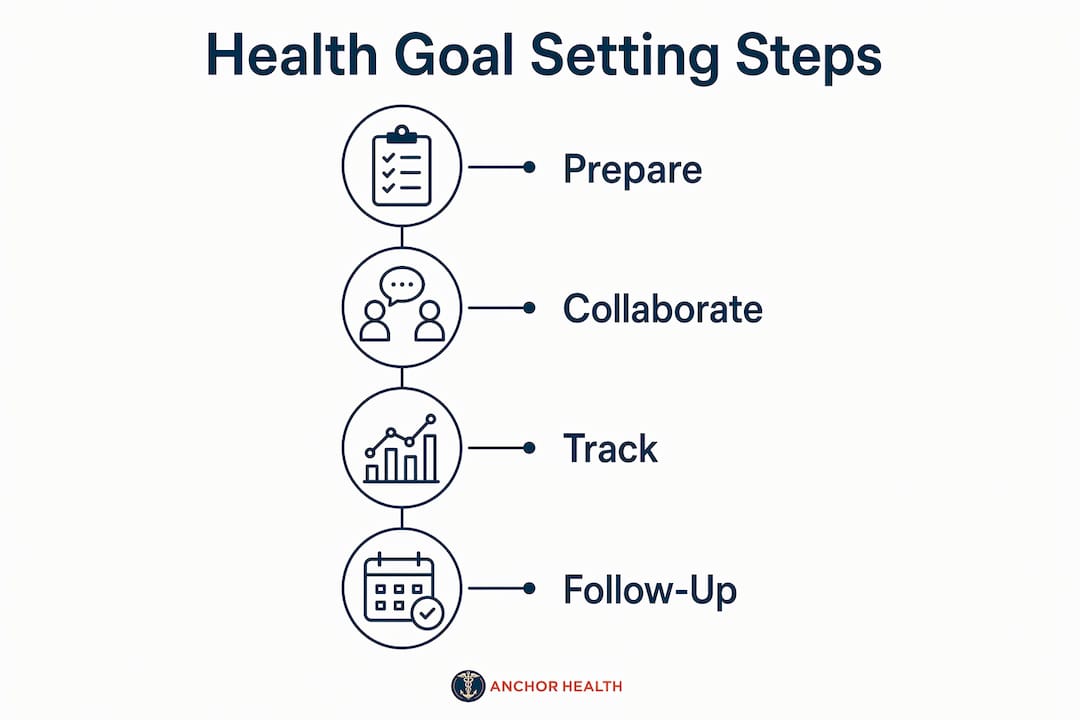
Setting health goals with a telehealth provider is defined as a structured, ongoing clinical process that combines personalized consultation, measurable benchmarks, and continuous follow-up support. This is not a one-time video call. It is a framework built on credential verification, coordinated care, and consistent provider relationships. Patients who approach telehealth wellness planning with preparation and realistic expectations consistently achieve better outcomes than those who treat it as a quick fix. This guide walks you through every step, from your first appointment to long-term progress tracking.
How to set health goals with a telehealth provider: what it really means
Health goal setting in telehealth is the clinical practice of co-creating personalized, measurable objectives with a licensed provider through secure video visits. The industry term for this process is collaborative care planning, and it differs from generic wellness advice in one critical way: a credentialed clinician reviews your full medical history before recommending any target. Telehealth health objectives only work when they are grounded in your actual baseline, not a generic template. Myanchorhealthpc builds this process into every patient relationship through its Anchored Care℠ᴵᴾ model, which prioritizes continuity over episodic treatment.
The most common mistake patients make is expecting a single appointment to produce a complete plan. Effective remote health goals planning requires an initial consultation of 30–60 minutes, followed by structured follow-up visits every 3–4 weeks to review progress and refine targets. That cadence is not arbitrary. It reflects the time your body and habits need to respond to change, and the time your provider needs to assess whether the plan is working.

What you need before your first telehealth health goal-setting appointment
Preparation determines the quality of your first session. Patients who arrive with organized information give their provider the context needed to set goals that actually fit their life.
Gather the following before your appointment:
- Current medications and dosages, including supplements
- Recent lab results (within the past 12 months if available)
- A summary of chronic conditions or past diagnoses
- Your daily routine, including sleep schedule, diet patterns, and physical activity level
- Insurance information and your primary care history
Most telehealth platforms require you to complete an intake form before your visit, which typically takes 10–15 minutes. Completing it thoroughly saves time during the appointment and helps your provider skip the basics and focus on your goals.
Credential verification is non-negotiable before you book. Verifying a provider’s credentials takes about 10 minutes and protects you from misdiagnosis and insurance denials. Check three things: an active state license in the state where you will be located during the visit, board certification through the American Board of Medical Specialties (ABMS), and a valid National Provider Identifier (NPI). Telehealth providers must be licensed in the state where you are physically located during the visit, not where their practice is based. Confirm this through your state medical board’s website.
Technical preparation matters too. Test your camera, microphone, and internet connection at least 30 minutes before the appointment. Choose a private, well-lit space where you can speak freely. A poor connection or noisy environment shortens the time your provider can spend on your goals.
Pro Tip: Write down your top three health concerns and one specific goal before the appointment. Providers cover more ground when patients arrive with a clear starting point.
Also confirm that the platform uses HIPAA-compliant encrypted video. Platforms without proper data protection can jeopardize your privacy and complicate insurance billing. This is a baseline requirement, not a premium feature.
How do you collaborate with your provider to set realistic health goals?
Realistic goal setting starts with a thorough review of your medical history and current lifestyle. Your provider is not guessing. They are identifying the gap between where you are and where you can safely go, given your conditions, medications, and daily constraints.
Effective telehealth health objectives cover four areas:
- Nutrition: Specific dietary adjustments based on your lab results and health conditions, not generic eating advice
- Movement: Activity targets matched to your current fitness level and any physical limitations
- Mental wellbeing: Screening for stress, anxiety, or depression that may affect your ability to follow through
- Sleep: Identifying patterns that undermine metabolic health, energy, and mood
Multidisciplinary telehealth programs that integrate dietitian-led appointments with lifestyle support across all four areas show stronger goal achievement than single-provider models. This coordinated approach means your nutrition plan does not conflict with your movement goals, and your mental health support reinforces both. Myanchorhealthpc applies this integrated thinking across its primary care, weight and metabolic health, and mental health services.
“Successful telehealth goal setting requires multidisciplinary support beyond willpower. Nutrition, movement, and mental wellbeing guidance must be integrated into your daily routine, not treated as separate programs.”
Setting measurable benchmarks is what separates a goal from a wish. A goal like “lose weight” has no timeline and no checkpoint. A clinical goal reads: “Reduce fasting glucose by 10 points within 8 weeks through dietary changes and 150 minutes of weekly moderate activity.” Your provider assigns the target, the timeline, and the method. You agree to it together. That shared ownership is what makes the goal stick.
You can also learn how to communicate your care needs more effectively before your first session, which shortens the time it takes to reach a plan you both believe in.
Best practices for tracking progress through telehealth follow-ups
Progress tracking is where most virtual health goal strategies succeed or fail. Patients who attend follow-ups consistently are far more likely to reach their targets than those who check in only when something goes wrong.
A structured follow-up schedule looks like this:
- Week 1–2: Self-monitoring using tools provided at your initial visit (food logs, step counts, sleep tracking)
- Week 3–4: First follow-up appointment to review early data, address barriers, and adjust the plan if needed
- Month 2–3: Deeper review of lab markers or weight trends, with goal refinement based on results
- Month 4 and beyond: Quarterly check-ins to maintain momentum and set new targets as initial goals are met
Secure patient portals are the connective tissue between appointments. Patient portals enable ongoing communication, medication refill requests, and progress tracking between visits. Use them actively. Send a message when you hit a barrier. Upload your home blood pressure readings. Ask your provider to review a lab result before your next appointment. Patients who use portals consistently stay on track with their personalized plans.
| Follow-up stage | Primary focus |
|---|---|
| Weeks 1–2 | Self-monitoring and habit building |
| Weeks 3–4 | First review and barrier identification |
| Months 2–3 | Lab or metric review and goal refinement |
| Month 4+ | Sustained progress and new target setting |
Real-world barriers are predictable. Work stress, travel, family demands, and cost concerns all disrupt health plans. A good telehealth provider addresses these directly during follow-ups rather than assuming the original plan still fits. Structured lifestyle programs that extend support between appointments with practical tools and education reduce dropout rates and sustain behavior change over time.
Pro Tip: Before each follow-up, write down one thing that worked and one thing that did not. This two-sentence summary gives your provider exactly what they need to adjust your plan efficiently.
For patients managing chronic conditions, consistent telehealth follow-ups also reduce reliance on emergency care. Myanchorhealthpc’s approach to chronic disease telehealth management integrates goal tracking directly into primary care visits, so your health objectives and your medical management stay aligned.
What mistakes should you avoid when setting health goals via telehealth?
Several predictable errors undermine telehealth health goal planning. Knowing them in advance protects your health and your investment.
- Skipping credential verification: Booking with an unlicensed or out-of-state provider creates legal and insurance problems. Always confirm the NPI and state license before your first visit.
- Choosing platforms without HIPAA compliance: Unencrypted platforms expose your health data and may not qualify for insurance reimbursement.
- Treating telehealth as episodic care: A single consultation does not produce lasting change. Successful goal achievement requires treating telehealth as a continuous, structured program with consistent clinical oversight.
- Prioritizing cost over credentials: Platforms led by non-clinician health coaches often provide less safe care. Clinical oversight matters more than a lower session price, especially for patients managing chronic conditions or medications.
- Over-relying on AI chatbots: Automated goal-setting tools cannot replace a licensed clinician’s judgment.
“Human clinicians provide nuanced problem-solving tailored to real-life challenges. AI tools assist remote goal setting, but human healthcare providers deliver superior support for complex health situations.”
The last point deserves emphasis. AI-driven wellness apps can track steps and log meals. They cannot interpret your lab results in the context of your medications, adjust your plan when you develop a new symptom, or recognize when a goal is unsafe given your history. Human-facilitated telehealth remains the standard for addressing complex health goals. Choose a provider, not a chatbot.
Key Takeaways
Setting health goals with a telehealth provider requires credential verification, structured follow-ups, and multidisciplinary support to produce lasting results.
| Point | Details |
|---|---|
| Verify credentials first | Confirm active state license, ABMS board certification, and a valid NPI before booking. |
| Prepare before your first visit | Complete intake forms and gather medical history to maximize your initial consultation. |
| Set measurable benchmarks | Pair every goal with a specific timeline and metric, not a general intention. |
| Use follow-ups consistently | Schedule reviews every 3–4 weeks to track progress and adjust your plan in real time. |
| Choose human clinical oversight | Licensed providers outperform AI tools for complex, personalized health goal planning. |
What I’ve learned about telehealth goal setting that most articles skip
The biggest gap I see between patients who succeed and those who stall is not motivation. It is the expectation that a telehealth provider will hand them a plan and the work is done. The plan is the starting point, not the destination.
What actually moves the needle is what happens between appointments. Patients who log their meals, track their sleep, and send a portal message when something feels off give their provider the data needed to make meaningful adjustments. Patients who show up to follow-ups with nothing to report get generic encouragement instead of a refined plan. The quality of your follow-up determines the quality of your care.
Credential verification also matters more than most patients realize. I have seen people spend months working toward goals set by a health coach with no clinical license, only to discover the plan was not medically appropriate for their condition. Ten minutes on your state medical board’s website prevents that entirely.
Telehealth genuinely democratizes access to quality health coaching. A working parent in a rural county can access the same level of coordinated care as someone in a major city, provided they choose a credentialed provider on a secure platform. That access is only valuable if you use it consistently and treat it as an ongoing relationship, not a one-time transaction.
— Paule
Myanchorhealthpc: telehealth care built around your health goals
Myanchorhealthpc is a Maryland-based telehealth primary care provider that builds every patient relationship around personalized, measurable health goals. Its Anchored Care℠ᴵᴾ model prioritizes continuity, so your provider knows your history, your barriers, and your progress at every visit.
Whether you are managing a chronic condition, working on weight and metabolic health, or addressing mental and emotional wellbeing, Myanchorhealthpc connects you with credentialed, board-certified providers on a HIPAA-compliant platform. The practice accepts insurance and offers membership options for patients who want more frequent access and enhanced support. If you are ready to move from intention to a structured plan, start by reviewing how to choose telehealth primary care that fits your family’s needs.
FAQ
What does it mean to set health goals with a telehealth provider?
Setting health goals with a telehealth provider means co-creating measurable, personalized clinical objectives through secure video visits with a licensed clinician. The process includes an initial consultation, structured follow-ups, and ongoing lifestyle support.
How often should I meet with my telehealth provider to review my goals?
Follow-up appointments are typically scheduled every 3–4 weeks, depending on your care plan and the complexity of your health objectives.
What credentials should I verify before booking a telehealth health goal session?
Confirm an active state license in the state where you will be located, board certification through the ABMS, and a valid NPI. This verification takes about 10 minutes and protects you from misdiagnosis and insurance issues.
Can an AI chatbot replace a telehealth provider for health goal setting?
No. Human clinicians provide nuanced, medically grounded problem-solving that AI tools cannot replicate, particularly for patients managing chronic conditions or complex health histories.
How do I prepare for my first telehealth health goal appointment?
Complete your intake form thoroughly before the visit, gather recent lab results and a medication list, and write down your top three health concerns. Test your camera and internet connection at least 30 minutes in advance.
Recommended
- How to Communicate Care Needs to Your Telehealth Provider
- How to Balance Caregiving Work with Telehealth
- Chronic Disease Telehealth Management Tips That Work
Blog & Information Disclaimer
Last Updated: May 23, 2026
The information provided on the Anchor Health website (https://myanchorhealthpc.com/), including but not limited to blog posts, articles, newsletters, graphics, and other materials (collectively, the "Content"), is for general informational and educational purposes only.
By accessing and using this website, you acknowledge and agree to the following terms and conditions:
The Content on this website is not intended to be a substitute for professional medical advice, diagnosis, or treatment. Always seek the advice of your physician, nurse practitioner, or other qualified health provider with any questions you may have regarding a medical condition. Never disregard professional medical advice or delay in seeking it because of something you have read on this website.
Reading, interacting with, or sharing the Content on this website does not establish a patient-provider relationship between you and Anchor Health or any of its clinicians, including Paule Valery Joseph, PhD, MBA, CRNP, FAAN. A formal patient-provider relationship is only established after you have completed the formal intake process, signed our clinical consent forms, and participated in a secure clinical consultation.
If you are experiencing a medical emergency, call 911 or seek emergency medical services immediately.
Anchor Health is a primary care practice and does not provide emergency or crisis intervention services through its website or blog.
While Anchor Health strives to provide thoughtful, evidence-based information grounded in our Anchored Care℠ model, healthcare is a rapidly evolving field. We make no representations or warranties, express or implied, about the completeness, accuracy, reliability, or suitability of the information contained in the Content. Any reliance you place on such information is strictly at your own risk.
Anchor Health is a telehealth practice providing services to patients physically located within the state of Maryland. The information provided on this blog is intended for residents of Maryland and is governed by the laws and regulations of that state. Accessing this information from outside of Maryland does not imply that our clinicians are licensed to practice medicine or provide consultations in your jurisdiction.
Content related to Weight & Metabolic Health, including discussions of GLP-1 medications or other medical therapies, is provided for educational context regarding our clinical approach. Prescriptions and specific medical recommendations are only made following a comprehensive clinical evaluation, diagnostic testing, and shared decision-making within a formal patient-provider relationship.
This website may contain links to external websites that are not provided or maintained by or in any way affiliated with Anchor Health. Please note that Anchor Health does not guarantee the accuracy, relevance, timeliness, or completeness of any information on these external websites.
To the fullest extent permitted by law, Anchor Health, its owners, and its employees shall not be liable for any direct, indirect, incidental, consequential, or punitive damag
Related posts