Primary Care’s Role in Chronic Disease Management

Primary care is defined as the first and most consistent point of contact for patients managing long-term health conditions, and its role in chronic disease management directly determines whether those conditions stay controlled or spiral into crisis. Adults with a regular primary care source have 11% fewer emergency visits and 20% fewer hospitalizations related to chronic diseases. The Robert Graham Center and the Milbank Memorial Fund both identify primary care as the most underfunded and underutilized tool in reducing the burden of conditions like diabetes, hypertension, and heart disease. When primary care works well, it does not just treat symptoms. It prevents the next hospitalization before it happens.
What is the role of primary care in chronic disease management?
Primary care serves as the continuous, coordinated foundation for managing chronic illness across a patient’s lifetime. Unlike specialist visits, which focus on a single condition or organ system, primary care addresses the whole person. That distinction matters because most patients with chronic illness carry more than one diagnosis at the same time.
The Milbank Memorial Fund describes primary care as uniquely positioned to prevent chronic disease progression through longitudinal, trusting relationships. That trust enables earlier detection of warning signs that a patient might dismiss or a specialist might miss without full context. A primary care clinician who has seen you for three years notices when your energy drops, your weight shifts, or your blood pressure trends upward before those changes become emergencies.
Chronic disease expenditures are 54% lower for adults with consistent primary care access. That figure reflects fewer hospitalizations, fewer specialist referrals driven by delayed diagnosis, and better medication management over time. The importance of primary care in health management is not theoretical. It shows up directly in cost, outcomes, and quality of life.
How does primary care detect and monitor chronic diseases over time?
Early detection is one of the clearest strengths of primary care. Routine screenings for blood pressure, blood glucose, cholesterol, and body weight create a baseline that makes change visible. A single abnormal reading is a data point. A pattern across multiple visits is a diagnosis in progress.
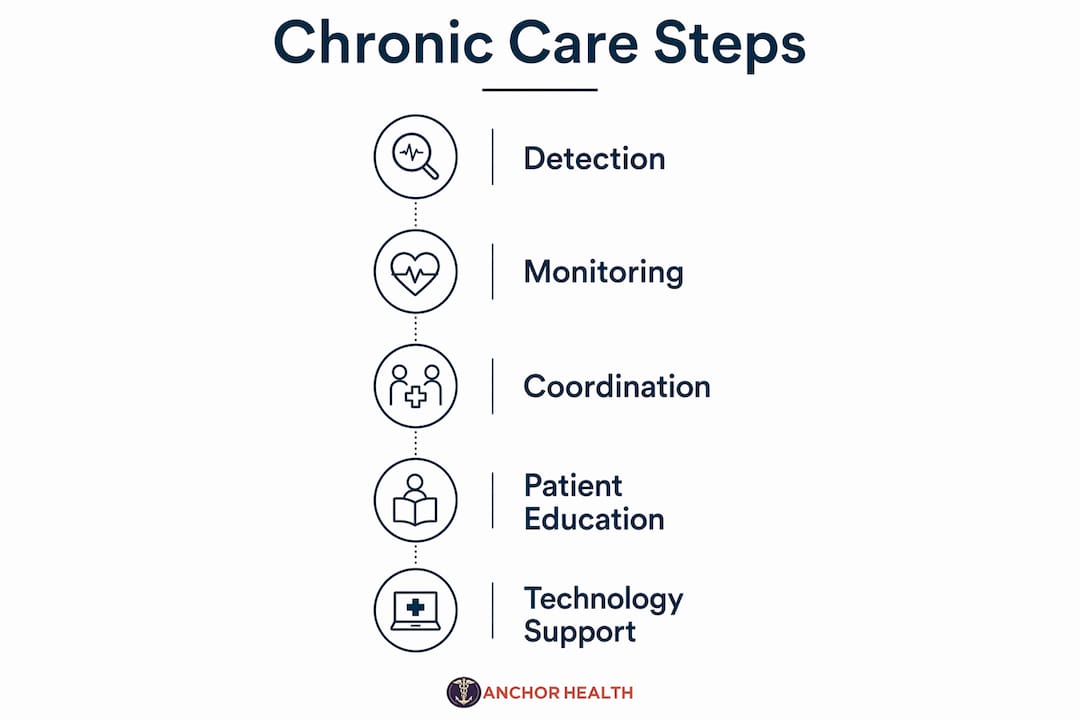
Longitudinal relationships give primary care clinicians a clinical advantage that no specialist visit can replicate. When a patient comes in every six months, the clinician builds a mental model of what “normal” looks like for that individual. Deviations from that baseline trigger earlier investigation. The Milbank Memorial Fund confirms that proactive management through these ongoing relationships leads to fewer crises and better long-term control.
Monitoring technology has expanded what primary care teams can track between visits. Blood pressure cuffs, continuous glucose monitors, and pulse oximeters now feed data directly into care plans. Remote monitoring programs with active patient engagement show positive impacts on quality of life and medication safety. That means your primary care team can adjust your treatment before your next scheduled appointment, not after a problem has already escalated.
Effective chronic disease care also requires integrating condition-specific templates into a unified whole-person plan. A patient managing both Type 2 diabetes and depression needs a care plan that addresses both, not two separate checklists that never speak to each other. The Annals of Family Medicine identifies fragmented, condition-specific care as a primary driver of poor outcomes in patients with multiple diagnoses.
- Routine screenings: blood pressure, HbA1c, lipid panels, and BMI at every relevant visit
- Longitudinal tracking: comparing current readings to your personal historical baseline
- Remote monitoring: home devices that transmit data to your care team between visits
- Integrated care templates: unified plans that address all active diagnoses together
Pro Tip: Keep a simple log of your home readings, whether blood pressure, blood sugar, or weight, and bring it to every primary care visit. Your clinician can spot trends in five minutes that would otherwise take months of appointments to identify.
How does care coordination work in chronic illness management?
Care coordination is a dynamic, multi-layered process where primary care acts as the central hub connecting patients to specialists, pharmacies, mental health providers, and community resources. The Springer research on care coordination defines this hub model as the most effective structure for reducing hospital readmissions and preventing fragmented care. Without a coordinating center, patients with multiple conditions often receive conflicting advice from providers who are not communicating with each other.

Multidisciplinary teams are the engine of effective coordination. A well-functioning primary care team includes nurses managing follow-up calls, pharmacists reviewing medication interactions, behavioral health counselors addressing mental health, and care managers tracking referral completion. Each role fills a gap that a single clinician cannot cover alone.
| Team member | Coordination role |
|---|---|
| Primary care clinician | Oversees the full care plan and makes referral decisions |
| Registered nurse | Manages follow-up, patient education, and care gap alerts |
| Clinical pharmacist | Reviews medications for interactions and adherence barriers |
| Behavioral health counselor | Addresses depression, anxiety, and health behavior change |
| Care manager | Tracks specialist referrals and community resource connections |
Hospital-to-home transitions are among the highest-risk moments in chronic disease care. Patients discharged after a hospitalization face new medications, changed dosages, and follow-up instructions that can conflict with their existing care plan. Medication reconciliation at discharge and a timely primary care follow-up appointment are the two interventions most likely to prevent a return hospitalization within 30 days.
Shared records and communication protocols make coordination possible at scale. When your specialist sends a visit summary directly to your primary care clinician, your care team can respond to changes in your treatment without waiting for your next scheduled visit. That speed matters when a medication change or new diagnosis requires immediate adjustment to your overall plan.
Pro Tip: Always bring your hospital discharge summary to your first primary care visit after any hospitalization. That document contains medication changes, new diagnoses, and follow-up instructions your primary care team needs to keep your care plan current.
How does primary care support patient education and self-management?
Shared decision-making is the standard that separates effective chronic disease care from passive treatment. The Annals of Family Medicine shows that co-created management plans improve patient engagement and align care with individual priorities and lifestyle. When you help design your own care plan, you are more likely to follow it.
Patient education in primary care covers more than medication instructions. It includes understanding what your condition does to your body, recognizing warning signs that require urgent attention, and knowing which lifestyle changes produce the greatest impact for your specific diagnosis. A patient who understands why they take a medication is far more likely to take it consistently than one who was simply handed a prescription.
Structured care plans formalize this education into a document you can reference at home. A strong care plan lists your active diagnoses, current medications with dosages and timing, warning signs that require a call or visit, and contact information for each member of your care team. That structure reduces confusion and gives you a clear framework for managing your health day to day.
Telehealth has expanded access to chronic disease self-management support for patients who cannot attend frequent in-person visits. Video visits allow primary care teams to review home monitoring data, adjust medications, and provide education without requiring travel. Digital tools also support behavioral health integration, which is critical because conditions like depression and anxiety directly affect how well patients manage physical chronic illness.
Key components of effective patient education in primary care include:
- Medication education: purpose, dosage, timing, and side effects to watch for
- Lifestyle guidance: specific dietary, activity, and sleep recommendations tied to your diagnosis
- Symptom recognition: clear criteria for when to call, when to visit, and when to go to the emergency room
- Self-monitoring skills: how to use home devices and what readings require action
- Behavioral health support: addressing the emotional weight of living with a chronic condition
Do integrated care models and technology improve chronic disease outcomes?
Systems-based primary care models produce measurable improvements in clinical markers. Integrated approaches improve systolic blood pressure and HbA1c in adults managing multiple chronic conditions. Those two markers are among the most reliable indicators of long-term cardiovascular and metabolic risk, so moving them in the right direction has real consequences for how long and how well patients live.
Medication safety improves significantly when multidisciplinary teams review prescriptions together. A pharmacist embedded in a primary care practice catches interactions that a busy clinician reviewing a chart alone might miss. Structured monitoring and coordinated follow-up are the specific elements most consistently linked to better outcomes across chronic disease populations.
Remote care management programs extend the reach of primary care into patients’ daily lives. Digital remote care programs increase patient autonomy, promote continuous monitoring, and reduce unnecessary emergency visits. Programs that include caregivers in the design show stronger results because the support system around a patient is as important as the clinical interventions themselves.
The evidence does carry an honest limitation. Long-term hard endpoints, meaning outcomes like mortality rates and major cardiac events, require more study before researchers can draw firm conclusions about which specific interventions produce the most durable results. What the current evidence does confirm is that the combination of structured monitoring, medication optimization, and coordinated follow-up consistently moves intermediate markers in the right direction. That is a strong foundation for continued investment in primary care as the center of chronic disease management.
Key Takeaways
Primary care is the most effective system for managing chronic disease because it combines continuous monitoring, coordinated team care, and personalized education into a single, ongoing relationship.
| Point | Details |
|---|---|
| Continuous monitoring reduces crises | Longitudinal relationships allow earlier detection of warning signs before they become emergencies. |
| Care coordination prevents fragmentation | A primary care hub connecting specialists, pharmacists, and community resources reduces readmissions. |
| Shared decision-making improves adherence | Co-created care plans align treatment with your lifestyle, making consistent follow-through more likely. |
| Technology extends primary care reach | Remote monitoring and telehealth allow medication adjustments and education between scheduled visits. |
| Integrated teams improve clinical markers | Multidisciplinary primary care models measurably reduce blood pressure and HbA1c in chronic disease patients. |
Why primary care deserves to be your health headquarters
I have seen patients cycle through specialist after specialist, collecting diagnoses and prescriptions, while nobody coordinates the full picture. That pattern is not a failure of the specialists. It is a failure to use primary care the way it was designed to be used.
The most effective patients I have observed treat their primary care clinician as a health headquarters, not a gatekeeper. They bring their specialist notes, their home monitoring logs, and their questions about medications that were prescribed by someone who did not know their full history. That active participation changes the quality of every conversation.
What I find consistently true is that trust and continuity are not soft benefits. They are clinical tools. A patient who trusts their provider shares symptoms earlier. Earlier disclosure leads to earlier intervention. Earlier intervention prevents the hospitalizations that fragment care and erode quality of life.
Healthcare systems need to support primary care with the training, staffing, and time required to do this work well. Visit time limits and condition-specific templates push clinicians toward reactive, fragmented care. The family doctor’s preventive role only functions when the system gives clinicians the space to see the whole person, not just the presenting complaint.
My honest recommendation: if you are managing a chronic condition, invest in your primary care relationship the same way you invest in your specialist relationships. Show up prepared, ask questions, and co-create your care plan. That partnership is the most reliable path to better outcomes.
— Paule
Chronic disease care that stays with you through Myanchorhealthpc
Managing a chronic condition requires consistent, attentive care that does not disappear between appointments. Myanchorhealthpc delivers that continuity through secure video visits, giving Maryland patients access to a primary care team that knows their full health history and coordinates care across every provider involved in their treatment.
Through its Anchored Care℠ᴵᴾ model, Myanchorhealthpc connects patients with clinicians who specialize in long-term relationship-based care, including chronic disease monitoring, medication management, and behavioral health support. If you are ready to build a primary care relationship that actively supports your health goals, choosing the right telehealth provider is the clearest next step. You can also explore telehealth management strategies that work specifically for chronic conditions.
FAQ
What does primary care do for chronic disease patients?
Primary care provides continuous monitoring, medication management, care coordination, and patient education for individuals with long-term conditions. It serves as the central hub connecting patients to specialists and community resources while tracking health trends over time.
How does care coordination reduce hospitalizations?
Effective care coordination, especially during hospital-to-home transitions, reduces readmissions by managing medication reconciliation and scheduling timely follow-up visits. Coordinated primary care prevents the gaps in communication that most often lead to preventable returns to the hospital.
Can telehealth support chronic disease management effectively?
Telehealth supports chronic disease management by enabling remote monitoring, medication adjustments, and patient education between in-person visits. Digital remote care programs increase patient autonomy and reduce unnecessary emergency visits when designed with active patient engagement.
What is shared decision-making in primary care?
Shared decision-making is a process where the clinician and patient co-create a care plan that reflects both clinical evidence and the patient’s personal priorities and lifestyle. Research from the Annals of Family Medicine shows this approach improves engagement and treatment adherence.
How does primary care lower chronic disease costs?
Adults with consistent primary care access have chronic disease expenditures that are 54% lower than those without a regular care source. Fewer hospitalizations, earlier interventions, and better medication management account for the majority of that difference.
Recommended
- Chronic Disease Telehealth Management Tips That Work
- The Role of Family Doctor in Preventive Care
- Family Primary Care Best Practices for Every Age
- Primary Care’s Role in Caregiver Preventive Screenings
Blog & Information Disclaimer
Last Updated: May 23, 2026
The information provided on the Anchor Health website (https://myanchorhealthpc.com/), including but not limited to blog posts, articles, newsletters, graphics, and other materials (collectively, the "Content"), is for general informational and educational purposes only.
By accessing and using this website, you acknowledge and agree to the following terms and conditions:
The Content on this website is not intended to be a substitute for professional medical advice, diagnosis, or treatment. Always seek the advice of your physician, nurse practitioner, or other qualified health provider with any questions you may have regarding a medical condition. Never disregard professional medical advice or delay in seeking it because of something you have read on this website.
Reading, interacting with, or sharing the Content on this website does not establish a patient-provider relationship between you and Anchor Health or any of its clinicians, including Paule Valery Joseph, PhD, MBA, CRNP, FAAN. A formal patient-provider relationship is only established after you have completed the formal intake process, signed our clinical consent forms, and participated in a secure clinical consultation.
If you are experiencing a medical emergency, call 911 or seek emergency medical services immediately.
Anchor Health is a primary care practice and does not provide emergency or crisis intervention services through its website or blog.
While Anchor Health strives to provide thoughtful, evidence-based information grounded in our Anchored Care℠ model, healthcare is a rapidly evolving field. We make no representations or warranties, express or implied, about the completeness, accuracy, reliability, or suitability of the information contained in the Content. Any reliance you place on such information is strictly at your own risk.
Anchor Health is a telehealth practice providing services to patients physically located within the state of Maryland. The information provided on this blog is intended for residents of Maryland and is governed by the laws and regulations of that state. Accessing this information from outside of Maryland does not imply that our clinicians are licensed to practice medicine or provide consultations in your jurisdiction.
Content related to Weight & Metabolic Health, including discussions of GLP-1 medications or other medical therapies, is provided for educational context regarding our clinical approach. Prescriptions and specific medical recommendations are only made following a comprehensive clinical evaluation, diagnostic testing, and shared decision-making within a formal patient-provider relationship.
This website may contain links to external websites that are not provided or maintained by or in any way affiliated with Anchor Health. Please note that Anchor Health does not guarantee the accuracy, relevance, timeliness, or completeness of any information on these external websites.
To the fullest extent permitted by law, Anchor Health, its owners, and its employees shall not be liable for any direct, indirect, incidental, consequential, or punitive damag
Related posts