Why Working Adults Delay Medical Appointments: Key Reasons

Working adults most often delay medical appointments because time constraints at work combine with scheduling friction, cost concerns, and psychological barriers that make postponing care feel like the only practical option. According to the National Health Statistics Reports, a significant share of U.S. adults delayed or skipped medical care in 2022 due to at least one nonfinancial access barrier, and many specifically cited being too busy with work or other commitments. Cost and insurance gaps compound the problem further, and the COVID-19 pandemic layered in new avoidance behaviors that have not fully resolved.
The good news: practical fixes exist. Telehealth, flexible scheduling, digital self-booking, and employer leave policies each reduce the friction that keeps working adults from getting care they need. Understanding the full picture is the first step toward changing it.
- Top drivers: work and time conflicts, scheduling friction, cost and insurance gaps, medical anxiety, pandemic-related avoidance
- Most affected groups: lower-income workers, uninsured or underinsured adults, shift workers, caregivers, racial and ethnic minority groups
- Proven fixes: telehealth, evening and weekend clinic hours, automated reminders, self-scheduling tools, paid medical leave
Table of Contents
- How common is delayed medical care among U.S. adults?
- Why working adults delay medical appointments: the main drivers
- Who is most likely to delay care?
- What happens when you keep delaying care?
- How COVID-19 changed care-seeking behavior
- Evidence-backed steps that reduce appointment delays
- How telehealth specifically helps working adults get care
- How cultural attitudes shape whether adults seek care
- How workplace culture affects your ability to schedule appointments
- How language barriers and communication gaps delay care
- Key Takeaways
- The system, not the patient, is where most fixes need to happen
- Myanchorhealthpc makes primary care work for your schedule
- Authoritative sources and further reading
How common is delayed medical care among U.S. adults?
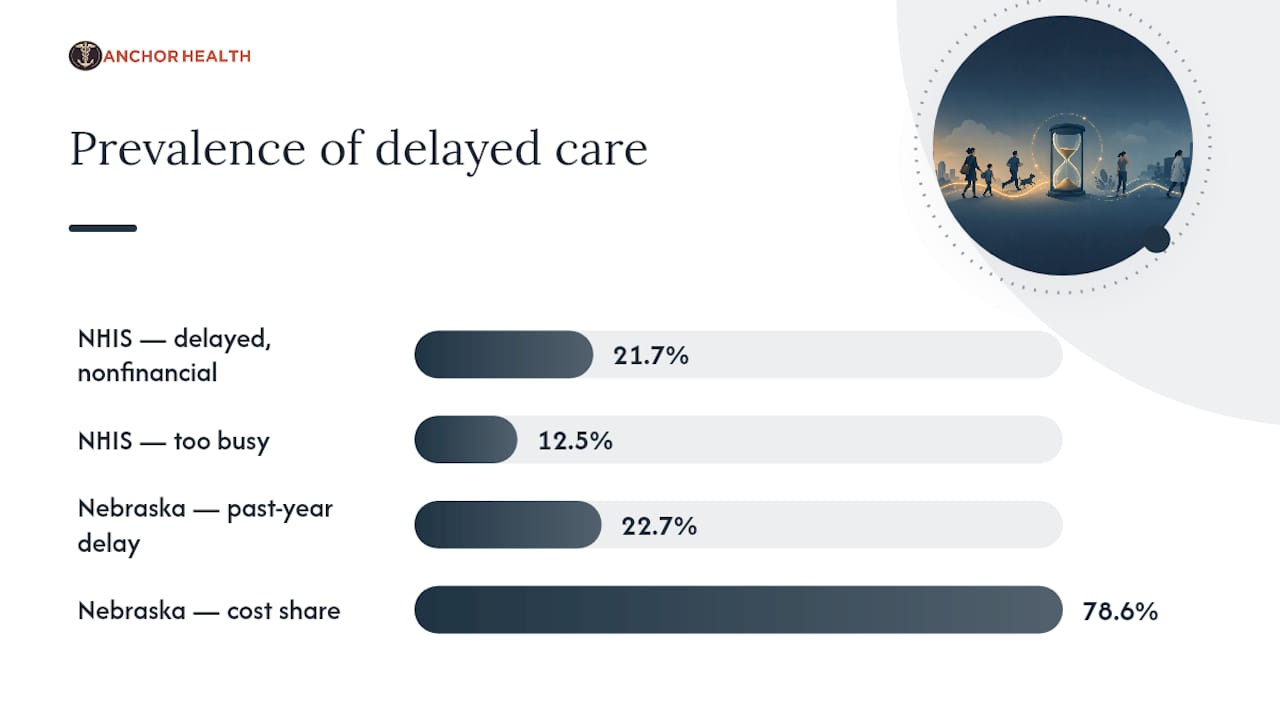
The scale of deferred care in the United States is larger than most people assume. The NHIS-based National Health Statistics Reports found that more than one in five U.S. adults reported delaying or forgoing care in 2022 due to nonfinancial barriers alone. That figure does not include the millions who skipped care specifically because of cost.
A cross-sectional study of Nebraska adults found that more than one-third of the sample had ever delayed care and 22.7% had done so in the past 12 months, with cost accounting for 78.6% of those delays in that sample. The Federal Reserve’s 2025 report on U.S. household economic well-being documented that a substantial share of insured Americans deferred care because of affordability pressures or gaps in their benefits, signaling that having insurance does not fully protect against cost-driven delay.
| Statistic | Source | What it tells us |
|---|---|---|
| 21.7% delayed care for a nonfinancial barrier | NHIS 2022 | More than 1 in 5 adults face access friction beyond cost |
| 12.5% cited being “too busy” | NHIS 2022 | Work and time conflict is the single largest nonfinancial reason |
| A notable portion of adults reported being unable to get an available appointment | NHIS 2022 | Scheduling supply is a distinct barrier from patient busyness |
| More than one-third of the sample had ever delayed care | Nebraska cross-sectional study | Lifetime delay rates are far higher than annual snapshots suggest |
| Cost was the dominant factor attributed to delays in care | Nebraska cross-sectional study | Financial barriers dominate when measured across a full sample |
These numbers reflect a system under strain. Primary care workforce shortages, documented in the 2026 Economic Report of the President, mean that even motivated patients face long waits and limited slot availability, which pushes delay rates higher regardless of individual intent.
Why working adults delay medical appointments: the main drivers
The reasons for delaying doctor visits are rarely one-dimensional. For most working adults, several barriers stack on top of each other.
Time poverty and work conflicts
The single most reported nonfinancial reason adults skip care is being too busy, per the NHIS data above. A typical short medical appointment often requires several hours of a patient’s day when considering travel, parking, waiting, and lost work time. Most workers cannot absorb that without using paid time off, and many do not have paid leave at all.
Scheduling friction
Analysis of healthcare scheduling patterns shows that new-patient waits are extended, often lasting several weeks, and the majority of available slots cluster during weekday business hours, precisely when most employed adults are at work. Evening and weekend availability remains limited at many practices.
Financial barriers
Cost is the dominant driver when measured across the full population. Out-of-pocket costs, high deductibles, and insurance compatibility issues all contribute. The MDPI study on delayed care confirms that financial barriers and medical anxiety remain two of the most consistently reported reasons adults skip appointments, even in recent data.
Psychological barriers
Medical anxiety, embarrassment, and the tendency to minimize symptoms (“it’s probably nothing”) are underappreciated drivers. Low health literacy also plays a role: adults who are less confident interpreting symptoms or navigating the healthcare system are more likely to wait until a problem becomes impossible to ignore.
Logistical barriers
Transportation, childcare, and clinic hours that do not align with work schedules create compounding friction. The NHIS data shows 4.6% of adults could not get to a provider when the office was open, and 2.4% cited travel distance as a barrier. For shift workers and caregivers, these numbers likely understate the real burden.
Pro Tip: If you cannot take a full morning off for a routine visit, ask your provider specifically about early-morning, lunchtime, or telehealth slots before assuming none exist. Many practices hold these slots but do not advertise them prominently.
Who is most likely to delay care?
Not all working adults face equal risk. Sociodemographic patterns from NHIS and CDC data show clear concentrations of delay among specific groups.
- Uninsured and underinsured adults: — Adults without insurance or with high-deductible plans face the steepest financial friction. The Federal Reserve’s household data confirms that even insured adults with benefits gaps defer care at meaningful rates.
- Caregivers: Adults managing childcare or elder care face a double burden: their own appointments compete with the appointments of those they care for. Caregiver-specific access barriers are well-documented and often overlooked in standard access research.
- Racial and ethnic minority groups: — Structural barriers including transportation, language, and insurance gaps concentrate delay rates in Black, Hispanic, and other minority communities, compounding health equity concerns.
Primary care workforce strain, detailed in the 2026 Economic Report of the President, means supply-side constraints amplify all of these individual-level barriers. When there are fewer available providers and longer waits, the groups with the least scheduling flexibility are the first to fall through the cracks.
What happens when you keep delaying care?
Deferred care rarely stays neutral. Short-term delays become long-term health risks, and the costs accumulate for individuals and employers alike.
- Worsened health outcomes: — Conditions caught early, from hypertension to diabetes to certain cancers, are substantially less complex and less costly to treat. Delayed detection means more advanced disease at diagnosis and more aggressive treatment requirements.
- Chronic disease progression: For adults already managing a chronic condition, missed follow-up appointments allow medication adjustments to slip, lab values to drift, and complications to develop. Understanding the difference between reactive and preventive healthcare is central to appreciating why continuity matters.
How COVID-19 changed care-seeking behavior
The pandemic produced a sharp, well-documented spike in delayed care. The CDC MMWR report from June 2020 documented widespread avoidance of routine and nonemergency care due to exposure concerns and service disruptions during the early pandemic period. Adults across all demographics delayed appointments they would otherwise have kept.
Two lasting effects stand out. First, telehealth adoption accelerated dramatically. Patients who had never used a video visit were forced to try it, and many found it adequate or preferable for certain visit types. That behavioral shift has persisted. Second, a subset of adults developed a lasting pattern of avoidance, either from residual exposure concern or from having broken the habit of regular care during the disruption.
| Behavior | Early pandemic (2020) | Post-pandemic trend |
|---|---|---|
| Routine care avoidance | Widespread, driven by exposure fear | Partially recovered; some avoidance persists |
| Telehealth use | Rapid adoption under necessity | Sustained; now a standard option for many patients |
| Preventive screening rates | Sharply declined | Still below pre-pandemic baselines in some categories |
| Exposure concern as a barrier | Primary driver of delay | Reduced but not eliminated for high-risk individuals |
The pandemic also exposed how fragile routine care habits are. Adults who had been seeing a provider regularly lost that continuity, and re-establishing a relationship with a consistent provider has proven harder than expected for many.
Evidence-backed steps that reduce appointment delays
Reducing delays requires changes at the system level, the employer level, and the individual level. The most effective interventions address multiple barriers at once.
System-level changes
- Automated reminders via text or app reduce no-shows meaningfully. Practice-level data shows that digital reminders and self-service rescheduling improve attendance, particularly among time-poor patients who prefer text or digital contact over phone calls.
- Telehealth for appropriate visit types — removes travel and waiting-room time entirely, lowering the threshold for addressing early symptoms.
Employer-level changes
- Paid medical leave policies that do not require workers to choose between income and care
- Flexible scheduling that allows mid-day appointments without penalty
- Benefits design that reduces out-of-pocket cost friction, including lower deductibles and co-pays for preventive visits
- On-site or near-site clinic access for larger employers
Patient-level tactics
Pro Tip: For time-poor workers, a telehealth “micro-visit” for a single concern (a new medication question, a lab result review, a mental health check-in) is clinically appropriate for many common issues and takes a fraction of the time of an in-person appointment. Ask your provider which visit types they can handle via video.
How telehealth specifically helps working adults get care
Consider a working adult who notices elevated blood pressure readings on a home monitor. An in-person appointment might mean a 31-day wait, a half-day off work, and a round trip across town. A telehealth visit with a consistent provider can happen from a lunch break, a parked car, or a home office, often within days of the request.
The evidence behind this is practical. Digital scheduling and automated reminders reduce no-shows. Video visits remove the auxiliary time cost that makes a 15-minute consultation feel like a two-hour commitment. For caregivers managing both their own health and a child’s or parent’s, telehealth removes barriers that would otherwise make consistent care nearly impossible.
Telehealth does have real limits. Physical examinations, certain diagnostic procedures, and some acute presentations require in-person care. A relationship-based telehealth provider will tell you clearly when an in-person visit is necessary rather than trying to handle everything remotely. That honesty is part of what makes the model trustworthy.
Pro Tip: Before your first telehealth visit, write down your top two or three concerns in order of priority. Providers can cover more ground when patients arrive prepared, and you are less likely to leave a short visit feeling like the most important issue went unaddressed.
How cultural attitudes shape whether adults seek care
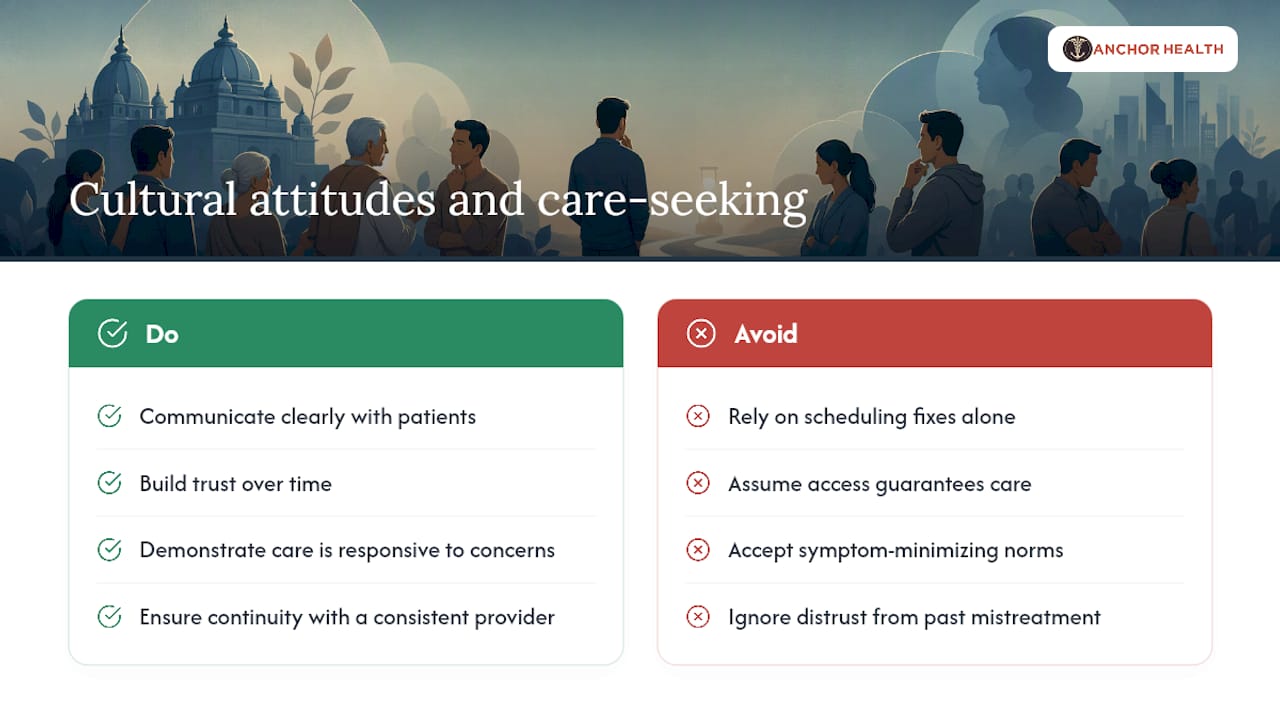
Cultural and societal attitudes toward medical care shape appointment adherence in ways that scheduling fixes alone cannot address. In many communities, seeking care for symptoms that are not yet disabling is seen as unnecessary or even as a sign of weakness. Men, in particular, are socialized in many American cultural contexts to minimize symptoms and avoid medical settings until a problem becomes acute.
Distrust of the medical system is another significant factor, especially in communities with historical experiences of medical mistreatment or discrimination. Adults who distrust providers are less likely to schedule preventive visits, less likely to follow through on referrals, and more likely to delay care even when they have insurance and access.
Health fatalism, the belief that health outcomes are largely predetermined and that medical intervention will not make a meaningful difference, also reduces appointment adherence. This attitude tends to be more prevalent in communities with lower health literacy or limited experience with successful preventive care outcomes.
Addressing these attitudes requires more than operational fixes. It requires providers who communicate clearly, build trust over time, and demonstrate that care is genuinely responsive to the patient’s concerns. Continuity with a consistent provider is one of the most effective tools for shifting these attitudes gradually.
How workplace culture affects your ability to schedule appointments
Workplace culture has a direct and often underappreciated effect on whether employed adults can act on their intention to get care. In workplaces where taking time off for medical appointments is implicitly discouraged, or where employees fear being seen as less committed, many workers simply do not go.
Formal policies matter, but informal norms matter just as much. An employer can offer paid medical leave on paper while maintaining a culture where using it carries a professional cost. Workers in those environments learn quickly that the policy exists but is not truly available to them.
Hourly workers face the starkest version of this problem. Missing a shift for a medical appointment often means lost wages with no replacement. For workers living close to the financial edge, that trade-off is not abstract: it is a direct choice between income and care.
Employers who want to reduce the downstream costs of untreated illness, including absenteeism, presenteeism, and higher insurance claims, have a clear business case for creating genuinely flexible scheduling norms, not just written policies. Managers who model using medical time without apology signal to their teams that the policy is real.
How language barriers and communication gaps delay care
Language proficiency is a concrete barrier to healthcare access for a significant portion of the U.S. workforce. Adults with limited English proficiency face friction at every step: understanding appointment instructions, communicating symptoms accurately, interpreting discharge paperwork, and following up on referrals. Each friction point increases the likelihood of delay or avoidance.
Even among English-speaking adults, health literacy gaps create similar problems. Medical terminology, insurance explanations, and referral processes are genuinely confusing for many patients. Adults who do not understand what a referral means, or who cannot interpret a lab result letter, often do nothing rather than risk asking a question they fear will mark them as uninformed.
Practices that offer interpreter services, multilingual patient materials, and plain-language communication reduce these barriers directly. Telehealth platforms that support asynchronous messaging give patients time to process information and formulate questions without the pressure of a real-time conversation, which can be especially helpful for patients navigating care in a second language.
Key Takeaways
Working adults delay medical appointments primarily because time constraints, scheduling friction, and cost barriers stack together in ways that make postponing care feel unavoidable.
| Point | Details |
|---|---|
| Time conflict is the top nonfinancial barrier | Many U.S. adults cited being too busy as the reason they delayed care, according to NHIS 2022 data. |
| Cost dominates when measured broadly | In a cross-sectional study, 78.6% of delayed care was attributed to cost, affecting insured and uninsured adults alike. |
| Scheduling supply is a distinct problem | New-patient waits average around 31 days, and most slots cluster during standard work hours, blocking employed adults. |
| Telehealth and digital tools reduce delays | Automated reminders, self-scheduling, and video visits each lower the friction that causes working adults to defer care. |
| Myanchorhealthpc offers telehealth primary care | Maryland adults can access relationship-based video visits through Myanchorhealthpc, accepting insurance and self-pay. |
The system, not the patient, is where most fixes need to happen
The conventional framing of delayed care focuses on patient behavior: people need to prioritize their health, make time, stop procrastinating. That framing puts the burden in the wrong place. The appointment model most American primary care practices still use was designed for a household structure that no longer exists, one that assumed someone at home could manage logistics during business hours.
The evidence points clearly to structural causes. Slots cluster at 9 to 5. New-patient waits stretch past a month. A routine visit consumes hours of a working adult’s day. Insurance gaps make cost a real calculation even for people with coverage. These are design problems, not willpower problems.
What actually moves the needle is operational: evening hours, telehealth for appropriate visit types, digital scheduling that works at 10 PM, automated reminders that reduce the cognitive load of managing appointments. Small changes in how care is delivered produce measurable improvements in who shows up. The patients who benefit most are the ones the current system is least designed to serve: hourly workers, caregivers, shift workers, and adults managing chronic conditions while holding down demanding jobs.
Myanchorhealthpc makes primary care work for your schedule
If the barriers described in this article sound familiar, you are not alone, and the solution does not have to be complicated. Myanchorhealthpc delivers relationship-based primary care entirely through secure video visits, which means no commute, no waiting room, and no half-day off work for a routine follow-up. We accept insurance, self-pay, HSA, and FSA funds, and our optional membership plan offers extended visits and structured follow-up for adults managing ongoing health needs.
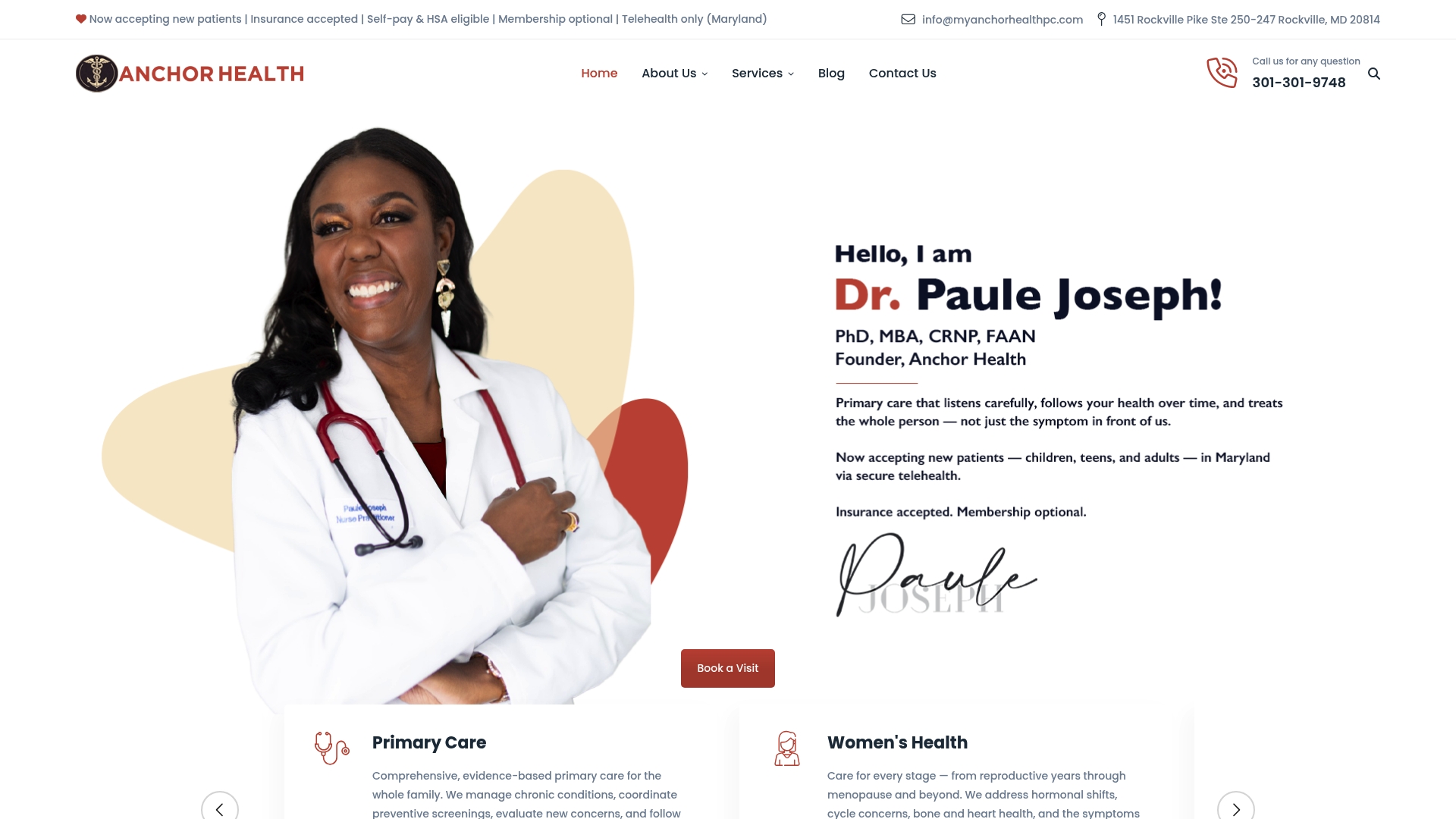
We serve adults, families, and children across Maryland, covering general primary care, women’s health, men’s health, mental and emotional health within primary care scope, and weight and metabolic health management. Every visit is with a consistent provider who knows your history, which means you spend your appointment time on your actual concerns rather than re-explaining your background.
If you are ready to find a care model that fits your life, choosing the right telehealth primary care relationship is a practical next step. Book a visit with Myanchorhealthpc and see what primary care looks like when it is built around your schedule, not the other way around.
This article provides general health information and is not a substitute for professional medical advice. Please consult a qualified provider for guidance specific to your situation.
Authoritative sources and further reading
- National Health Statistics Reports, Number 207, August 1, 2024
- Factors associated with delaying medical care: cross-sectional study of Nebraska adults
- Delay or Avoidance of Medical Care Because of COVID-19–Related Concerns — United States, June 2020 (CDC MMWR)
- Report on the Economic Well-Being of U.S. Households, Federal Reserve (2025)
Recommended
- Preventive Care for Ages 18–25: Your 2026 Guide
- Managing Family Health Appointments Remotely in 2026
- How to Book a Telehealth Appointment as a Young Adult
Blog & Information Disclaimer
Last Updated: May 23, 2026
The information provided on the Anchor Health website (https://myanchorhealthpc.com/), including but not limited to blog posts, articles, newsletters, graphics, and other materials (collectively, the "Content"), is for general informational and educational purposes only.
By accessing and using this website, you acknowledge and agree to the following terms and conditions:
The Content on this website is not intended to be a substitute for professional medical advice, diagnosis, or treatment. Always seek the advice of your physician, nurse practitioner, or other qualified health provider with any questions you may have regarding a medical condition. Never disregard professional medical advice or delay in seeking it because of something you have read on this website.
Reading, interacting with, or sharing the Content on this website does not establish a patient-provider relationship between you and Anchor Health or any of its clinicians, including Paule Valery Joseph, PhD, MBA, CRNP, FAAN. A formal patient-provider relationship is only established after you have completed the formal intake process, signed our clinical consent forms, and participated in a secure clinical consultation.
If you are experiencing a medical emergency, call 911 or seek emergency medical services immediately.
Anchor Health is a primary care practice and does not provide emergency or crisis intervention services through its website or blog.
While Anchor Health strives to provide thoughtful, evidence-based information grounded in our Anchored Care℠ model, healthcare is a rapidly evolving field. We make no representations or warranties, express or implied, about the completeness, accuracy, reliability, or suitability of the information contained in the Content. Any reliance you place on such information is strictly at your own risk.
Anchor Health is a telehealth practice providing services to patients physically located within the state of Maryland. The information provided on this blog is intended for residents of Maryland and is governed by the laws and regulations of that state. Accessing this information from outside of Maryland does not imply that our clinicians are licensed to practice medicine or provide consultations in your jurisdiction.
Content related to Weight & Metabolic Health, including discussions of GLP-1 medications or other medical therapies, is provided for educational context regarding our clinical approach. Prescriptions and specific medical recommendations are only made following a comprehensive clinical evaluation, diagnostic testing, and shared decision-making within a formal patient-provider relationship.
This website may contain links to external websites that are not provided or maintained by or in any way affiliated with Anchor Health. Please note that Anchor Health does not guarantee the accuracy, relevance, timeliness, or completeness of any information on these external websites.
To the fullest extent permitted by law, Anchor Health, its owners, and its employees shall not be liable for any direct, indirect, incidental, consequential, or punitive damag
Related posts