Telehealth Controlled Meds in Maryland Through 2026: Anchor Health

Yes, but with real limits. Federal rules let DEA-registered clinicians prescribe Schedule II through V controlled substances over video through December 31, 2026, and Maryland layers its own restrictions on top, especially for Schedule II opioids. Whether you get a prescription depends on your medication, your prior relationship with the practice, and whether your clinician has already examined you in person.
TL;DR:
- Telehealth prescribing of Schedule II to V medications is limited to December 31, 2026, with conditions such as real-time video visits and proper documentation.
- Maryland restricts Schedule II opioid prescriptions via telehealth unless the patient is in a licensed facility, there’s a declared emergency, or an in-person exam has already occurred.
- Clinicians must conduct thorough evaluations, including medical history, risk review, and possibly lab tests, during secure video sessions to prescribe controlled substances.
- Requesting controlled medications requires prior preparation, including gathering records, scheduling detailed appointments, and following up through the practice’s designated channels.
- If a clinician declines a request, patients can seek in-person exams, referrals, or explore non-controlled alternatives, with emphasis on ongoing, relationship-based care.
Table of Contents
- Controlled Substances Telehealth: What Federal Rules Allow Right Now
- Maryland’s Extra Rules for Opioids and Provider Licensing
- What Happens During a Telehealth Visit for a Controlled Medication
- How to Request a Controlled Prescription at Anchor Health
- If Your Clinician Says No, Here’s What Comes Next
- Why We Balance Access With Caution
- Getting Controlled Medication Support Through Anchor Health
- Where This Information Comes From
- Sources
Controlled Substances Telehealth: What Federal Rules Allow Right Now
The federal government’s stance on controlled substances telehealth changed the landscape for millions of patients, but the rule was never meant to be permanent. The Fourth Temporary Extension from the DEA and HHS lets DEA-registered practitioners prescribe Schedule II through V medications through interactive video visits, and this flexibility runs through December 31, 2026. After that date, the rules could tighten again.
A handful of conditions have to line up before a remote prescription is valid under this extension:
- The prescribing clinician must hold active DEA registration.
- The visit must happen over a real-time interactive telecommunications system, not a one-way message or form.
- The prescription must serve a legitimate medical purpose, documented in the chart.
- The clinician must follow federal recordkeeping standards under 21 CFR Part 1306.
Audio-only visits get a narrow carve-out, limited to certain medications for opioid use disorder, and even that exception comes with its own documentation trail. The DEA has been direct about why the extension exists: cutting off telehealth prescribing access abruptly hurts patients who depend on it.
The stakes are real. When similar flexibilities lapsed briefly in 2025, telemedicine visits dropped 24% nationally within 17 days, and some states saw declines approaching 40%. That is what happens when the rules shift under patients’ feet.
Maryland’s Extra Rules for Opioids and Provider Licensing
Federal flexibility does not override state law, and Maryland’s law is stricter than the federal baseline in one specific area: Schedule II opioids. Maryland restricts telehealth prescribing of these medications unless one of three narrow conditions is met, under provisions referenced in SB 372 / Chapter 481:
- The patient is physically located in a licensed health care facility at the time of the visit.
- Maryland has declared a state of emergency that triggers expanded telehealth allowances.
- The practitioner, or a colleague within the same group practice, has already conducted an in-person exam of that patient.
That third exception matters most for ongoing patients. If you have been seen in person by anyone in your practice’s group, you may already meet the bar for a bona fide practitioner-patient relationship, even if your video visit today is with someone new to you.
Maryland also requires any clinician treating a patient physically located in the state to hold a Maryland medical license, per Maryland Board of Physicians guidance under COMAR 10.32.05. Out-of-state clinicians generally cannot step in, except under temporary reciprocity provisions tied to a declared state emergency. This licensure rule exists specifically to keep telehealth care under Maryland’s regulatory eye, not to hand it off to whoever is licensed anywhere in the country.
What Happens During a Telehealth Visit for a Controlled Medication
Expect a more thorough visit than a routine checkup. Clinicians evaluating a controlled substance request have to build a defensible clinical record, and that takes real time.
- History and risk review. Your clinician asks about your medical history, current medications, and any risk factors relevant to the drug you are requesting.
- Legitimate medical purpose documentation. The visit notes have to support why this specific medication, at this specific dose, makes sense for you.
- Technology check. Interactive video is the standard requirement; audio-only is reserved for narrow OUD medication scenarios under federal guidance.
- Safeguards where appropriate. Depending on the medication, expect a controlled-substance agreement, a request for urine drug testing, lab orders, or a scheduled follow-up.
Pro Tip: Bring a list of every current medication and dosage to your visit, including supplements. Gaps in that list are one of the most common reasons a clinician asks for a follow-up before prescribing.
All of this happens over a secure, HIPAA-compliant connection. Maryland’s telehealth standard explicitly bars prescribing based on a static online questionnaire alone, which is one reason these evaluations tend to run longer than patients expect.
How to Request a Controlled Prescription at Anchor Health
Getting a request through smoothly starts before the visit even begins.
- Prepare your records. Gather ID, a current medication list, and notes on any prior in-person visits with Anchor Health or another Maryland provider.
- Book with specifics. When you schedule your visit, mention the medication and condition in your appointment request so your clinician can review your history beforehand.
- Attend the visit prepared to talk. Anchored Care℠ᴵᴾ is built around relationship-based evaluation, not a quick checkbox exam, so expect real conversation about your history and goals.
- Follow up as instructed. Prescriptions get transmitted electronically to your pharmacy once the visit concludes.
A few things to keep in mind:
- Monitoring plans, including scheduled check-ins, are common for ongoing controlled medications.
- Questions between visits go through the patient portal or office line, not a walk-in visit, since the practice is telehealth-only.
If Your Clinician Says No, Here’s What Comes Next
Clinicians decline controlled substance requests for real reasons, and it is worth understanding them rather than assuming something went wrong.
- Clinical inappropriateness. The medication may not fit your symptoms or history well enough to justify the risk.
- Diversion risk. Red flags in your history or requests may prompt caution.
- Missing prior in-person exam. For Schedule II opioids specifically, Maryland’s exam requirement may simply not be satisfied yet.
- Thin documentation. Sometimes the fix is as simple as gathering more records.
If you hit this wall, ask directly about a referral to a group-practice colleague who has completed an in-person exam, request an in-person visit to establish that relationship, or discuss non-controlled alternatives. If your situation is urgent, go to an emergency room rather than waiting on a telehealth resolution.
Why We Balance Access With Caution
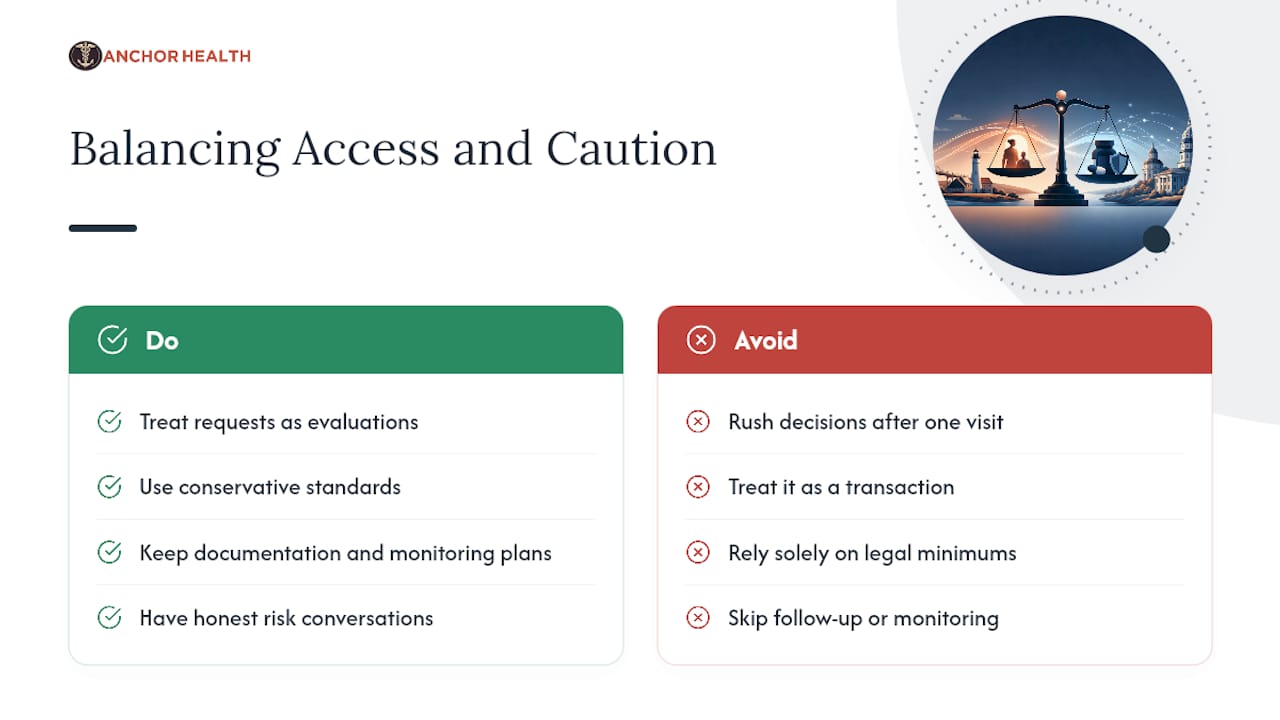
Continuity matters more than speed when a controlled medication is on the table. Anchor Health treats a controlled substance request as an evaluation, not a transaction, because a rushed decision made over one video call can create real harm down the line.
We often apply standards more conservative than the legal minimum, not because the law demands it, but because diversion risk and misdiagnosis are genuine possibilities that a single visit cannot always rule out. Documentation, monitoring plans, and honest conversations about risk are not obstacles. They are what let us keep prescribing safely, visit after visit, for patients we actually know.
— Paule
Getting Controlled Medication Support Through Anchor Health
Myanchorhealthpc gives Maryland patients something a walk-in urgent care or a one-off telehealth app cannot: a clinician who remembers your case and documents it consistently over time. That continuity is exactly what Maryland’s bona fide relationship rules reward, and it is why patients with ongoing medication needs often do better staying with one practice rather than bouncing between apps.
Booking starts with choosing the right telehealth primary care fit for your situation, whether that is a single visit or ongoing management. Bring your ID, medication list, and any prior records to your first appointment. For patients managing chronic conditions that involve controlled medications, Anchor Health’s membership option adds structured follow-up and easier access between visits. Schedule your visit today and bring your questions about eligibility directly to your clinician.
Where This Information Comes From
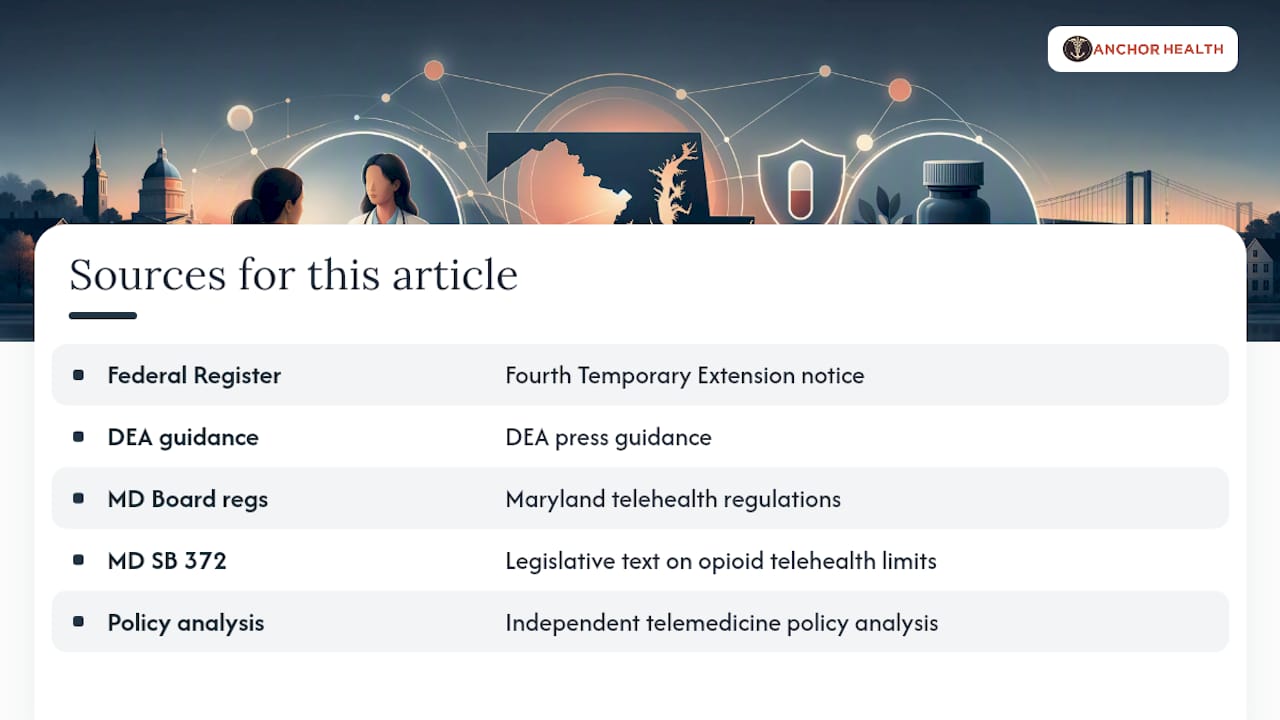
This article draws on the Federal Register’s Fourth Temporary Extension notice, DEA press guidance, Maryland Board of Physicians telehealth regulations, and Maryland’s SB 372 legislative text on opioid telehealth limits, alongside independent telemedicine policy analysis.
This article is general information, not a substitute for advice from a qualified doctor. Consult a qualified healthcare professional about your own circumstances before acting on anything here.
Sources
- Federal Register: Fourth Temporary Extension of COVID-19 Telemedicine Flexibilities for Prescription of Controlled Medications
- DEA: DEA extends telemedicine flexibilities to ensure continued access to care
- Maryland Board of Physicians: 10.32.05 Telehealth (COMAR guidance)
- Maryland legislature: SB 372 / Chapter 481 (telehealth and controlled substances provisions)
Recommended
- Set Up Your First Telehealth Account: Maryland Guide
- Doctor House Calls Maryland: Relationship-Based Telehealth
- Telehealth’s Role in Rural Maryland Healthcare Access
- How telehealth expands healthcare access for Maryland families
Blog & Information Disclaimer
Last Updated: May 23, 2026
The information provided on the Anchor Health website (https://myanchorhealthpc.com/), including but not limited to blog posts, articles, newsletters, graphics, and other materials (collectively, the "Content"), is for general informational and educational purposes only.
By accessing and using this website, you acknowledge and agree to the following terms and conditions:
The Content on this website is not intended to be a substitute for professional medical advice, diagnosis, or treatment. Always seek the advice of your physician, nurse practitioner, or other qualified health provider with any questions you may have regarding a medical condition. Never disregard professional medical advice or delay in seeking it because of something you have read on this website.
Reading, interacting with, or sharing the Content on this website does not establish a patient-provider relationship between you and Anchor Health or any of its clinicians, including Paule Valery Joseph, PhD, MBA, CRNP, FAAN. A formal patient-provider relationship is only established after you have completed the formal intake process, signed our clinical consent forms, and participated in a secure clinical consultation.
If you are experiencing a medical emergency, call 911 or seek emergency medical services immediately.
Anchor Health is a primary care practice and does not provide emergency or crisis intervention services through its website or blog.
While Anchor Health strives to provide thoughtful, evidence-based information grounded in our Anchored Care℠ model, healthcare is a rapidly evolving field. We make no representations or warranties, express or implied, about the completeness, accuracy, reliability, or suitability of the information contained in the Content. Any reliance you place on such information is strictly at your own risk.
Anchor Health is a telehealth practice providing services to patients physically located within the state of Maryland. The information provided on this blog is intended for residents of Maryland and is governed by the laws and regulations of that state. Accessing this information from outside of Maryland does not imply that our clinicians are licensed to practice medicine or provide consultations in your jurisdiction.
Content related to Weight & Metabolic Health, including discussions of GLP-1 medications or other medical therapies, is provided for educational context regarding our clinical approach. Prescriptions and specific medical recommendations are only made following a comprehensive clinical evaluation, diagnostic testing, and shared decision-making within a formal patient-provider relationship.
This website may contain links to external websites that are not provided or maintained by or in any way affiliated with Anchor Health. Please note that Anchor Health does not guarantee the accuracy, relevance, timeliness, or completeness of any information on these external websites.
To the fullest extent permitted by law, Anchor Health, its owners, and its employees shall not be liable for any direct, indirect, incidental, consequential, or punitive damag
Related posts